Sofia Lane is a nonfiction author known for writing thoughtful books on emotional resilience, self-growth, modern relationships, and finding meaning in everyday life. Her calm and reflective writing style combines psychology, philosophy, and practical insight to help readers navigate life with greater clarity, balance, and self-awareness.
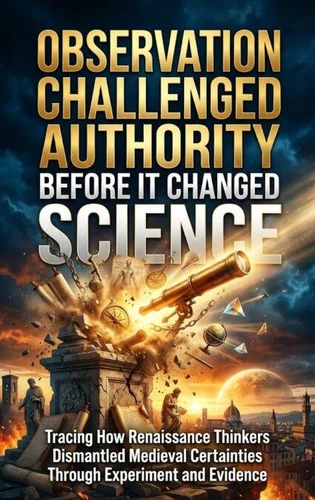
Observation Challenged Authority Before It Changed Science. Tracing How Renaissance Thinkers Dismantled Medieval Certainties Through Experiment and Evidence
Par :Formats :
Disponible dans votre compte client Decitre ou Furet du Nord dès validation de votre commande. Le format ePub est :
- Compatible avec une lecture sur My Vivlio (smartphone, tablette, ordinateur)
- Compatible avec une lecture sur liseuses Vivlio
- Pour les liseuses autres que Vivlio, vous devez utiliser le logiciel Adobe Digital Edition. Non compatible avec la lecture sur les liseuses Kindle, Remarkable et Sony
 , qui est-ce ?
Notre partenaire de plateforme de lecture numérique où vous retrouverez l'ensemble de vos ebooks gratuitement
Pour en savoir plus sur nos ebooks, consultez notre aide en ligne ici
C'est si simple ! Lisez votre ebook avec l'app Vivlio sur votre tablette, mobile ou ordinateur :

- Nombre de pages189
- FormatePub
- ISBN978-3-565-21066-4
- EAN9783565210664
- Date de parution30/01/2026
- Protection num.pas de protection
- Taille2 Mo
- Infos supplémentairesepub
- ÉditeurEmphaloz Publishing House
Résumé
The Scientific Revolution didn't begin with sudden breakthroughs-it emerged from a profound shift in how European thinkers approached knowledge itself. This book examines how Renaissance scholars gradually prioritized direct observation and reproducible experiment over inherited wisdom from ancient texts and Church doctrine, fundamentally altering humanity's relationship with the natural world.
Through manuscript collections, correspondence networks, and laboratory notebooks from figures like Galileo, Vesalius, and lesser-known experimenters, the narrative reveals the intellectual courage required to challenge Aristotelian physics, Galenic medicine, and geocentric cosmology.
These weren't merely scientific disputes but confrontations with institutional power-universities, religious authorities, and professional guilds all had stakes in maintaining established knowledge systems. The book traces how new instruments (telescopes, microscopes, accurate clocks) didn't just enhance human senses but created entirely new categories of observable phenomena that existing theories couldn't explain.
It follows the development of mathematical description as a legitimate way to understand nature, the rise of collaborative scientific communities through academies and journals, and the slow establishment of empirical evidence as arbiter of truth. Crucially, the narrative examines who could participate in this revolution-wealthy amateurs with leisure time, court-sponsored researchers, artisans whose practical knowledge informed theory-and who remained excluded, shaping which questions got asked and which observations counted as legitimate.
These weren't merely scientific disputes but confrontations with institutional power-universities, religious authorities, and professional guilds all had stakes in maintaining established knowledge systems. The book traces how new instruments (telescopes, microscopes, accurate clocks) didn't just enhance human senses but created entirely new categories of observable phenomena that existing theories couldn't explain.
It follows the development of mathematical description as a legitimate way to understand nature, the rise of collaborative scientific communities through academies and journals, and the slow establishment of empirical evidence as arbiter of truth. Crucially, the narrative examines who could participate in this revolution-wealthy amateurs with leisure time, court-sponsored researchers, artisans whose practical knowledge informed theory-and who remained excluded, shaping which questions got asked and which observations counted as legitimate.
A propos de Sofia Lane

4,49 €