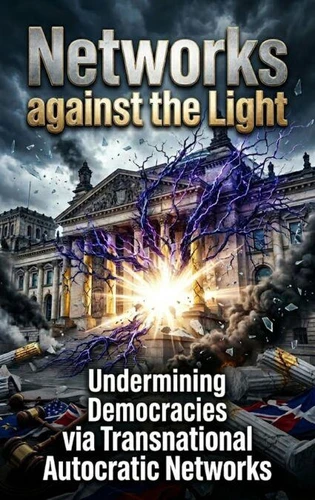
Networks against the Light. Undermining Democracies via Transnational Autocratic Networks
Par :Formats :
Disponible dans votre compte client Decitre ou Furet du Nord dès validation de votre commande. Le format ePub est :
- Compatible avec une lecture sur My Vivlio (smartphone, tablette, ordinateur)
- Compatible avec une lecture sur liseuses Vivlio
- Pour les liseuses autres que Vivlio, vous devez utiliser le logiciel Adobe Digital Edition. Non compatible avec la lecture sur les liseuses Kindle, Remarkable et Sony
 , qui est-ce ?
Notre partenaire de plateforme de lecture numérique où vous retrouverez l'ensemble de vos ebooks gratuitement
Pour en savoir plus sur nos ebooks, consultez notre aide en ligne ici
C'est si simple ! Lisez votre ebook avec l'app Vivlio sur votre tablette, mobile ou ordinateur :

- Nombre de pages184
- FormatePub
- ISBN978-3-565-40920-4
- EAN9783565409204
- Date de parution14/04/2026
- Protection num.pas de protection
- Taille2 Mo
- Infos supplémentairesepub
- ÉditeurEmphaloz Publishing House
Résumé
Democracy does not always fall at gunpoint. More often, in the twenty-first century, it is eroded from within - by elected leaders who exploit the very institutions they were chosen to protect, and by foreign powers who quietly supply the tools, the financing, and the ideological cover to accelerate that erosion. What has emerged is not a conspiracy in the classical sense, but something more durable and more dangerous: a transnational architecture of autocratic influence, operating across borders with increasing sophistication and impunity.
Networks against the Light traces the anatomy of this architecture.
It examines how Russia and China - the two dominant "authoritarian gravity centres" of the contemporary era - have developed divergent but complementary strategies for weakening democratic governance abroad. Russia exports disinformation, electoral interference, and paramilitary force, eroding the legitimacy of democratic institutions by flooding public discourse with manufactured doubt. China exports infrastructure, surveillance technology, and development assistance - binding governments through economic dependency while disseminating the digital tools of population control that have made its domestic authoritarianism so effective.
Together and separately, their influence has contributed to a measurable global democratic recession, with Freedom House recording consecutive years of democratic decline across more than sixty countries.
It examines how Russia and China - the two dominant "authoritarian gravity centres" of the contemporary era - have developed divergent but complementary strategies for weakening democratic governance abroad. Russia exports disinformation, electoral interference, and paramilitary force, eroding the legitimacy of democratic institutions by flooding public discourse with manufactured doubt. China exports infrastructure, surveillance technology, and development assistance - binding governments through economic dependency while disseminating the digital tools of population control that have made its domestic authoritarianism so effective.
Together and separately, their influence has contributed to a measurable global democratic recession, with Freedom House recording consecutive years of democratic decline across more than sixty countries.
A propos de Kian Tate





24,99 €