OFFRE LISEUSES
Une liseuse achetée = une housse offerte* jusqu'au 21 juin
- Accueil /
- Kian Tate
Kian Tate

Dernière sortie
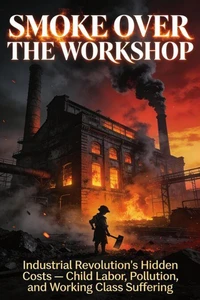
Smoke Over the Workshop
This book pulls aside the bright narrative of progress to reveal the dark underbelly of the Industrial Revolution: a world where steam engines and spinning mules were powered by exhausted children, poisoned air, and the grinding labour of an urban working class that paid the price for luxury it never touched. It argues that industrial modernity did not simply "happen, " but was built on a series of trade-offs-cheaper goods at the cost of human bodies, speed and efficiency at the expense of breathable air and clean water, and national wealth at the expense of a morality calibrated to the factory clock.
By moving from factory floors to coal-choked cities, the book traces the hidden ledger of the first industrial age. Child labour and exploitation form the first layer of this cost: children as young as five were employed for the same brutal hours as adults, paid a fraction of adult wages, and forced into roles where small bodies and nimble fingers served the machinery more profitably than conscience.
The second layer is pollution and environmental degradation: coal-fired factories and exploding cities poured soot and industrial waste into rivers and lungs, turning urban centres into zones of smog, cholera, and chronic respiratory disease, where workers lived and died amid the byproducts of their own production. The third layer is the suffering and disciplining of the working class: long shifts, dangerous machines, minimal safety regulation, and the constant threat of unemployment corroded health, family life, and dignity, leaving many workers with little more than hardship to show for the comforts that enriched others.
By moving from factory floors to coal-choked cities, the book traces the hidden ledger of the first industrial age. Child labour and exploitation form the first layer of this cost: children as young as five were employed for the same brutal hours as adults, paid a fraction of adult wages, and forced into roles where small bodies and nimble fingers served the machinery more profitably than conscience.
The second layer is pollution and environmental degradation: coal-fired factories and exploding cities poured soot and industrial waste into rivers and lungs, turning urban centres into zones of smog, cholera, and chronic respiratory disease, where workers lived and died amid the byproducts of their own production. The third layer is the suffering and disciplining of the working class: long shifts, dangerous machines, minimal safety regulation, and the constant threat of unemployment corroded health, family life, and dignity, leaving many workers with little more than hardship to show for the comforts that enriched others.
This book pulls aside the bright narrative of progress to reveal the dark underbelly of the Industrial Revolution: a world where steam engines and spinning mules were powered by exhausted children, poisoned air, and the grinding labour of an urban working class that paid the price for luxury it never touched. It argues that industrial modernity did not simply "happen, " but was built on a series of trade-offs-cheaper goods at the cost of human bodies, speed and efficiency at the expense of breathable air and clean water, and national wealth at the expense of a morality calibrated to the factory clock.
By moving from factory floors to coal-choked cities, the book traces the hidden ledger of the first industrial age. Child labour and exploitation form the first layer of this cost: children as young as five were employed for the same brutal hours as adults, paid a fraction of adult wages, and forced into roles where small bodies and nimble fingers served the machinery more profitably than conscience.
The second layer is pollution and environmental degradation: coal-fired factories and exploding cities poured soot and industrial waste into rivers and lungs, turning urban centres into zones of smog, cholera, and chronic respiratory disease, where workers lived and died amid the byproducts of their own production. The third layer is the suffering and disciplining of the working class: long shifts, dangerous machines, minimal safety regulation, and the constant threat of unemployment corroded health, family life, and dignity, leaving many workers with little more than hardship to show for the comforts that enriched others.
By moving from factory floors to coal-choked cities, the book traces the hidden ledger of the first industrial age. Child labour and exploitation form the first layer of this cost: children as young as five were employed for the same brutal hours as adults, paid a fraction of adult wages, and forced into roles where small bodies and nimble fingers served the machinery more profitably than conscience.
The second layer is pollution and environmental degradation: coal-fired factories and exploding cities poured soot and industrial waste into rivers and lungs, turning urban centres into zones of smog, cholera, and chronic respiratory disease, where workers lived and died amid the byproducts of their own production. The third layer is the suffering and disciplining of the working class: long shifts, dangerous machines, minimal safety regulation, and the constant threat of unemployment corroded health, family life, and dignity, leaving many workers with little more than hardship to show for the comforts that enriched others.
Les livres de Kian Tate
Nouveauté

Nouveauté

9,99 €
Nouveauté

9,99 €
Nouveauté

24,99 €
Nouveauté

9,99 €
Nouveauté

9,99 €
Nouveauté

24,99 €
Nouveauté

9,99 €
Nouveauté

24,99 €
Nouveauté

9,99 €
Nouveauté

9,99 €
Nouveauté

9,99 €
Nouveauté

9,99 €
Nouveauté

9,99 €