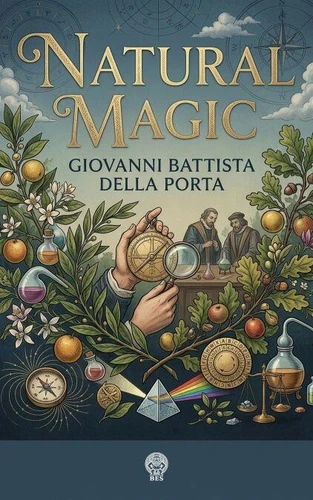
Before Galileo's telescope and Bacon's experiments, one Renaissance scholar had already spent decades testing the hidden forces of nature-and compiling them into a single, astonishing book. Giovanni Battista della Porta's *Natural Magic* is that book: a sprawling encyclopedia of practical secrets that shows you how to bend nature's powers to your own ends, from magnetism and optics to metallurgy, distillation, and the art of invisible writing.
Across twenty books, della Porta guides you through a world where science and wonder still speak the same language. You will learn how to graft plants into new hybrid forms, preserve fruits and foods against decay, refine metals, and extract the purest essences through distillation. You will discover the strange properties of the lodestone, the marvels of lenses and mirrors, and the workings of the camera obscura-described here with a clarity that would influence optical science for generations.
You will even find the secrets of cryptography and invisible inks, the tools of princes and spies. Throughout, della Porta draws a sharp line between the natural magic he practices and the forbidden arts of sorcery: his magus is no conjurer of spirits, but a patient observer who learns to assist nature toward its own hidden ends. This edition brings you the definitive 1589 version of the work-the expanded twenty-book masterpiece that secured della Porta's European fame-in a modern, readable English rendering designed for today's curious mind.
No archaic phrasing, no scholarly apparatus cluttering the page: just the direct encounter with a book that Francis Bacon, William Gilbert, and Robert Boyle all read with profit. For those who wish to go deeper, an introduction traces the author's turbulent life under the watchful eye of the Inquisition and the intellectual world that shaped his extraordinary synthesis of experiment and Hermetic philosophy.
Add this rediscovered classic to your library and see for yourself why della Porta's contemporaries called natural magic the perfection of natural philosophy-and why scientists were still claiming him as a colleague centuries later.
Before Galileo's telescope and Bacon's experiments, one Renaissance scholar had already spent decades testing the hidden forces of nature-and compiling them into a single, astonishing book. Giovanni Battista della Porta's *Natural Magic* is that book: a sprawling encyclopedia of practical secrets that shows you how to bend nature's powers to your own ends, from magnetism and optics to metallurgy, distillation, and the art of invisible writing.
Across twenty books, della Porta guides you through a world where science and wonder still speak the same language. You will learn how to graft plants into new hybrid forms, preserve fruits and foods against decay, refine metals, and extract the purest essences through distillation. You will discover the strange properties of the lodestone, the marvels of lenses and mirrors, and the workings of the camera obscura-described here with a clarity that would influence optical science for generations.
You will even find the secrets of cryptography and invisible inks, the tools of princes and spies. Throughout, della Porta draws a sharp line between the natural magic he practices and the forbidden arts of sorcery: his magus is no conjurer of spirits, but a patient observer who learns to assist nature toward its own hidden ends. This edition brings you the definitive 1589 version of the work-the expanded twenty-book masterpiece that secured della Porta's European fame-in a modern, readable English rendering designed for today's curious mind.
No archaic phrasing, no scholarly apparatus cluttering the page: just the direct encounter with a book that Francis Bacon, William Gilbert, and Robert Boyle all read with profit. For those who wish to go deeper, an introduction traces the author's turbulent life under the watchful eye of the Inquisition and the intellectual world that shaped his extraordinary synthesis of experiment and Hermetic philosophy.
Add this rediscovered classic to your library and see for yourself why della Porta's contemporaries called natural magic the perfection of natural philosophy-and why scientists were still claiming him as a colleague centuries later.

 , qui est-ce ?