
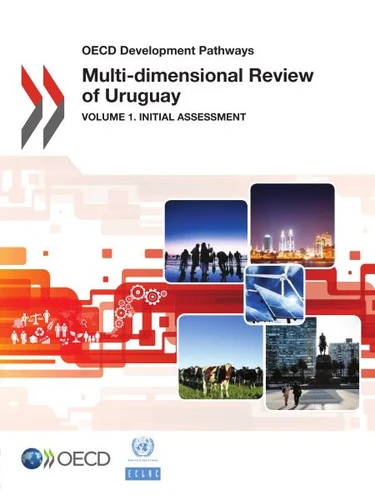
Multi-dimensional Review of Uruguay. Initial Assessment-volume
Par :Formats :
Disponible dans votre compte client Decitre ou Furet du Nord dès validation de votre commande. Le format PDF est :
- Compatible avec une lecture sur My Vivlio (smartphone, tablette, ordinateur)
- Compatible avec une lecture sur liseuses Vivlio
- Pour les liseuses autres que Vivlio, vous devez utiliser le logiciel Adobe Digital Edition. Non compatible avec la lecture sur les liseuses Kindle, Remarkable et Sony
 , qui est-ce ?
Notre partenaire de plateforme de lecture numérique où vous retrouverez l'ensemble de vos ebooks gratuitement
Pour en savoir plus sur nos ebooks, consultez notre aide en ligne ici
C'est si simple ! Lisez votre ebook avec l'app Vivlio sur votre tablette, mobile ou ordinateur :

- Nombre de pages188
- FormatPDF
- ISBN978-92-64-20945-9
- EAN9789264209459
- Date de parution14/08/2014
- Protection num.Digital Watermarking
- Taille5 Mo
- Infos supplémentairespdf
- ÉditeurOECD
Résumé
Uruguay has made remarkable progress over the past decade. Stable macroeconomic policies and a favourable external environment have permitted brisk growth and the financing of social policies. Substantial improvements in several dimensions of human well-being have occurred during this period, alongside considerable reductions in external risks. The conditions ahead, however, may present challenges to maintaining performance.
Overcoming these challenges will require finding the appropriate balance between long run objectives and macroeconomic and fiscal stability. One of the main obstacles to economic growth is the insufficient and inadequate provision of human capital and skills. A number of challenges remain for education, which, together with fiscal policy, are key means of reducing inequalities and sustaining economic growth.
In addition, Uruguay needs to address labour shortages to avoid constraints on future growth, especially as exports become more skills-intensive. It is important to orient social policies and expenditures towards the most vulnerable groups.
Overcoming these challenges will require finding the appropriate balance between long run objectives and macroeconomic and fiscal stability. One of the main obstacles to economic growth is the insufficient and inadequate provision of human capital and skills. A number of challenges remain for education, which, together with fiscal policy, are key means of reducing inequalities and sustaining economic growth.
In addition, Uruguay needs to address labour shortages to avoid constraints on future growth, especially as exports become more skills-intensive. It is important to orient social policies and expenditures towards the most vulnerable groups.
A propos de OCDE


32,99 €

72,99 €

33,99 €

32,99 €
32,99 €

32,00 €

25,00 €

Tax compilance by design
E-book
16,00 €

16,00 €

19,00 €

16,00 €


23,00 €

Women in business 2014
E-book
31,00 €


27,00 €