
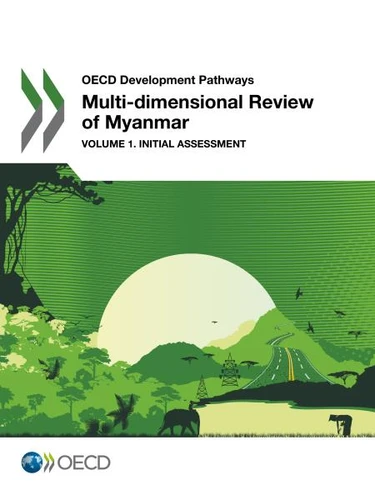
Multi-dimensional review of myanmar volume 1 initial assessment - oecd development pathways
Par :Formats :
Disponible dans votre compte client Decitre ou Furet du Nord dès validation de votre commande. Le format PDF est :
- Compatible avec une lecture sur My Vivlio (smartphone, tablette, ordinateur)
- Compatible avec une lecture sur liseuses Vivlio
- Pour les liseuses autres que Vivlio, vous devez utiliser le logiciel Adobe Digital Edition. Non compatible avec la lecture sur les liseuses Kindle, Remarkable et Sony
 , qui est-ce ?
Notre partenaire de plateforme de lecture numérique où vous retrouverez l'ensemble de vos ebooks gratuitement
Pour en savoir plus sur nos ebooks, consultez notre aide en ligne ici
C'est si simple ! Lisez votre ebook avec l'app Vivlio sur votre tablette, mobile ou ordinateur :

- Nombre de pages190
- FormatPDF
- ISBN978-92-64-20208-5
- EAN9789264202085
- Date de parution18/07/2013
- Protection num.Digital Watermarking
- Taille11 Mo
- Infos supplémentairespdf
- ÉditeurOECD
Résumé
This volume is the first of the OECD Development Pathways, a new series that looks at multiple development objectives beyond an exclusive focus on growth. The series starts with Myanmar, a country to be covered for the first time by the OECD. This initial assessment shows that Myanmar's success in achieving stable and sustainable growth will depend vitally on its ability to develop the institutional and social capital necessary to maintain macroeconomic and financial stability, to ensure the rule of law, to achieve environmentally sustainable development and to create an enabling environment for the private sector.
To be sustainable, growth also needs to be more equitable and inclusive. Seizing the momentum created by the country's opening and internal peace process will be imperative. Moreover, Myanmar's increasing population provides a demographic dividend which needs to be reaped in the next couple of decades to boost the potential of the economy. After that, the population will begin ageing and Myanmar risks getting old before the incomes and living standards of its people can significantly improve.
To be sustainable, growth also needs to be more equitable and inclusive. Seizing the momentum created by the country's opening and internal peace process will be imperative. Moreover, Myanmar's increasing population provides a demographic dividend which needs to be reaped in the next couple of decades to boost the potential of the economy. After that, the population will begin ageing and Myanmar risks getting old before the incomes and living standards of its people can significantly improve.
A propos de OCDE


32,99 €

72,99 €

33,99 €

32,99 €
32,99 €

32,00 €

25,00 €

Tax compilance by design
E-book
16,00 €

16,00 €

19,00 €

16,00 €


23,00 €

Women in business 2014
E-book
31,00 €


27,00 €