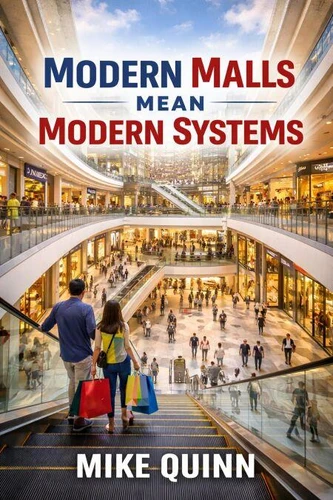
Modedrn Malls Mean Modern Systems. INFRASTRUCTURE ILLUSIONS, #1
Par :Formats :
Disponible dans votre compte client Decitre ou Furet du Nord dès validation de votre commande. Le format ePub est :
- Compatible avec une lecture sur My Vivlio (smartphone, tablette, ordinateur)
- Compatible avec une lecture sur liseuses Vivlio
- Pour les liseuses autres que Vivlio, vous devez utiliser le logiciel Adobe Digital Edition. Non compatible avec la lecture sur les liseuses Kindle, Remarkable et Sony
 , qui est-ce ?
Notre partenaire de plateforme de lecture numérique où vous retrouverez l'ensemble de vos ebooks gratuitement
Pour en savoir plus sur nos ebooks, consultez notre aide en ligne ici
C'est si simple ! Lisez votre ebook avec l'app Vivlio sur votre tablette, mobile ou ordinateur :

- FormatePub
- ISBN8233661082
- EAN9798233661082
- Date de parution22/02/2026
- Protection num.pas de protection
- Infos supplémentairesepub
- ÉditeurLinda Balsamo
Résumé
Modern malls create a powerful impression. Clean floors. Bright lighting. Reliable air-conditioning. Organized storefronts. Escalators moving continuously. Security staff visible. Restrooms maintained. Food courts operating smoothly. To a visitor or short-term observer, these spaces signal modern infrastructure. They look stable, efficient, and fully developed. This book examines that impression. The Philippines has invested heavily in large commercial complexes.
These structures function well within their boundaries. Power, water, maintenance, staffing, and climate control are concentrated and managed. The result is a controlled environment that resembles developed urban systems elsewhere. Visitors often assume that the surrounding city operates at the same level because the mall appears integrated with it. That assumption is incorrect. Commercial zones are engineered islands.
Resources are prioritized and systems are reinforced to sustain retail activity. Outside those boundaries, infrastructure operates under different constraints. Distribution networks, utilities, maintenance cycles, and service coverage vary widely by district. The contrast is structural, not temporary. Foreign residents frequently encounter this difference after relocation. Early impressions formed inside malls shape expectations about utilities, reliability, and service access.
Daily life then reveals a different operating environment. The gap between appearance and function becomes clear through routine experience. This book focuses on that gap. It does not criticize malls or deny their effectiveness. It analyzes the false inference that mall performance equals system-wide performance. Each chapter isolates one operational layer-power, water, maintenance, staffing, security, and surrounding context-to show how enclosed commercial reliability differs from broader infrastructure reality.
Understanding this distinction prevents misinterpretation. Malls demonstrate concentrated function. They do not represent general conditions. Recognizing that difference is essential for accurate expectations about living environments beyond commercial centers.
These structures function well within their boundaries. Power, water, maintenance, staffing, and climate control are concentrated and managed. The result is a controlled environment that resembles developed urban systems elsewhere. Visitors often assume that the surrounding city operates at the same level because the mall appears integrated with it. That assumption is incorrect. Commercial zones are engineered islands.
Resources are prioritized and systems are reinforced to sustain retail activity. Outside those boundaries, infrastructure operates under different constraints. Distribution networks, utilities, maintenance cycles, and service coverage vary widely by district. The contrast is structural, not temporary. Foreign residents frequently encounter this difference after relocation. Early impressions formed inside malls shape expectations about utilities, reliability, and service access.
Daily life then reveals a different operating environment. The gap between appearance and function becomes clear through routine experience. This book focuses on that gap. It does not criticize malls or deny their effectiveness. It analyzes the false inference that mall performance equals system-wide performance. Each chapter isolates one operational layer-power, water, maintenance, staffing, security, and surrounding context-to show how enclosed commercial reliability differs from broader infrastructure reality.
Understanding this distinction prevents misinterpretation. Malls demonstrate concentrated function. They do not represent general conditions. Recognizing that difference is essential for accurate expectations about living environments beyond commercial centers.
A propos de Mike Quinn


2,99 €







2,99 €


2,99 €