Focuses on entrepreneurship, branding, and creator-driven business models with a modern strategic perspective.
Nouveauté
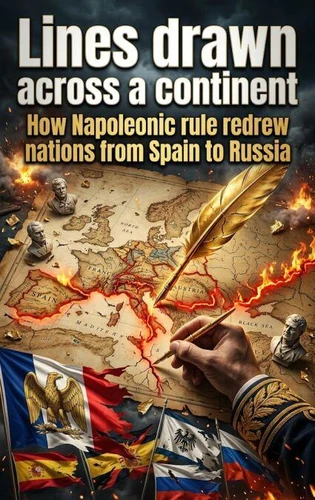
Lines drawn across a continent. How Napoleonic rule redrew nations from Spain to Russia
Par :Formats :
Disponible dans votre compte client Decitre ou Furet du Nord dès validation de votre commande. Le format ePub est :
- Compatible avec une lecture sur My Vivlio (smartphone, tablette, ordinateur)
- Compatible avec une lecture sur liseuses Vivlio
- Pour les liseuses autres que Vivlio, vous devez utiliser le logiciel Adobe Digital Edition. Non compatible avec la lecture sur les liseuses Kindle, Remarkable et Sony
 , qui est-ce ?
Notre partenaire de plateforme de lecture numérique où vous retrouverez l'ensemble de vos ebooks gratuitement
Pour en savoir plus sur nos ebooks, consultez notre aide en ligne ici
C'est si simple ! Lisez votre ebook avec l'app Vivlio sur votre tablette, mobile ou ordinateur :

- Nombre de pages214
- FormatePub
- ISBN978-3-565-55243-6
- EAN9783565552436
- Date de parution09/07/2026
- Protection num.pas de protection
- Taille686 Ko
- Infos supplémentairesepub
- ÉditeurEmphaloz Publishing House
Résumé
Before 1803, Europe was a patchwork of duchies, electorates, and free cities. By 1815, the map had been flattened and redrawn. The Napoleonic Wars did not merely shift borders-they invented the modern nation-state. In Spain, guerrilla warfare became a template for national resistance. In Germany, the dissolution of the Holy Roman Empire forced small states into new confederations. In Russia, the scorched-earth retreat shaped a national identity built on suffering and survival.
This book traces the administrative, legal, and territorial transformations that outlasted Napoleon himself. It examines how the Continental System restructured trade, how the Napoleonic Code replaced local laws, and how occupation governments became laboratories for modern bureaucracy. The wars did not end at Waterloo-they continued in the census forms, road networks, and tax codes that survived the empire.
From the Polish Legions to the British blockade, from Swiss neutrality to the Congress of Vienna, the book reveals how a decade of conflict permanently restructured European political geography.
This book traces the administrative, legal, and territorial transformations that outlasted Napoleon himself. It examines how the Continental System restructured trade, how the Napoleonic Code replaced local laws, and how occupation governments became laboratories for modern bureaucracy. The wars did not end at Waterloo-they continued in the census forms, road networks, and tax codes that survived the empire.
From the Polish Legions to the British blockade, from Swiss neutrality to the Congress of Vienna, the book reveals how a decade of conflict permanently restructured European political geography.