SOLDES
Jusqu'à -70% sur une sélection d'articles*

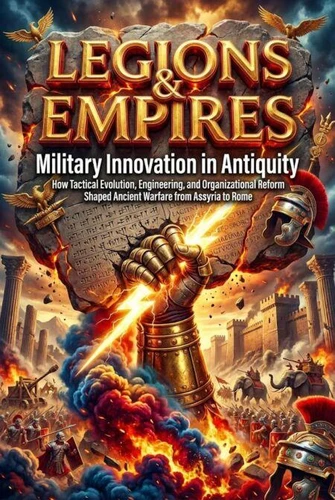
Legions & Empires: Military Innovation in Antiquity. How Tactical Evolution, Engineering, and Organizational Reform Shaped Ancient Warfare from Assyria to Rome
Par :Formats :
Disponible dans votre compte client Decitre ou Furet du Nord dès validation de votre commande. Le format ePub est :
- Compatible avec une lecture sur My Vivlio (smartphone, tablette, ordinateur)
- Compatible avec une lecture sur liseuses Vivlio
- Pour les liseuses autres que Vivlio, vous devez utiliser le logiciel Adobe Digital Edition. Non compatible avec la lecture sur les liseuses Kindle, Remarkable et Sony
 , qui est-ce ?
Notre partenaire de plateforme de lecture numérique où vous retrouverez l'ensemble de vos ebooks gratuitement
Pour en savoir plus sur nos ebooks, consultez notre aide en ligne ici
C'est si simple ! Lisez votre ebook avec l'app Vivlio sur votre tablette, mobile ou ordinateur :

- Nombre de pages242
- FormatePub
- ISBN978-3-565-24890-2
- EAN9783565248902
- Date de parution15/02/2026
- Protection num.pas de protection
- Taille2 Mo
- Infos supplémentairesepub
- ÉditeurEmphaloz Publishing House
Résumé
Military innovation determined which ancient civilizations expanded and which collapsed. This comprehensive study examines how tactical reforms, technological advances, and organizational changes transformed warfare across the ancient world-from Assyrian siege engines to Macedonian sarissas, from Carthaginian naval tactics to Roman engineering corps.
Drawing on archaeological finds, ancient military treatises, and battlefield archaeology, this book reveals how armies evolved beyond citizen militias into professional forces.
It explores the development of cavalry tactics, the integration of mercenary units, the logistics of supplying armies across vast distances, and the command structures that enabled coordinated operations. Each innovation is examined within its political, economic, and social context, showing how military reform both required and enabled imperial expansion. The narrative traces how successful innovations spread through conquest and adoption, how defeated powers learned from victors, and how technological advantages proved temporary without institutional adaptation.
It analyzes training methods, recruitment systems, medical care, and the integration of conquered peoples into military structures. Without romanticizing empire, this work provides rigorous analysis of how military innovation shaped ancient political power and left lasting institutional legacies.
It explores the development of cavalry tactics, the integration of mercenary units, the logistics of supplying armies across vast distances, and the command structures that enabled coordinated operations. Each innovation is examined within its political, economic, and social context, showing how military reform both required and enabled imperial expansion. The narrative traces how successful innovations spread through conquest and adoption, how defeated powers learned from victors, and how technological advantages proved temporary without institutional adaptation.
It analyzes training methods, recruitment systems, medical care, and the integration of conquered peoples into military structures. Without romanticizing empire, this work provides rigorous analysis of how military innovation shaped ancient political power and left lasting institutional legacies.
A propos de Selene Rothwell













8,49 €