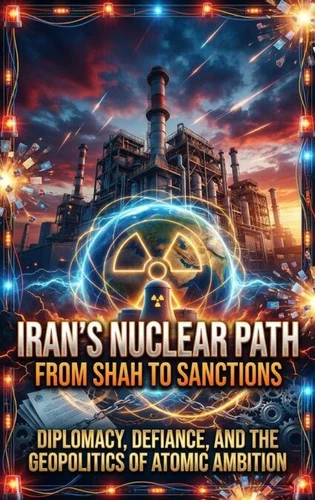
Iran's Nuclear Path: From Shah to Sanctions. Diplomacy, Defiance, and the Geopolitics of Atomic Ambition
Par :Formats :
Disponible dans votre compte client Decitre ou Furet du Nord dès validation de votre commande. Le format ePub est :
- Compatible avec une lecture sur My Vivlio (smartphone, tablette, ordinateur)
- Compatible avec une lecture sur liseuses Vivlio
- Pour les liseuses autres que Vivlio, vous devez utiliser le logiciel Adobe Digital Edition. Non compatible avec la lecture sur les liseuses Kindle, Remarkable et Sony
 , qui est-ce ?
Notre partenaire de plateforme de lecture numérique où vous retrouverez l'ensemble de vos ebooks gratuitement
Pour en savoir plus sur nos ebooks, consultez notre aide en ligne ici
C'est si simple ! Lisez votre ebook avec l'app Vivlio sur votre tablette, mobile ou ordinateur :

- Nombre de pages214
- FormatePub
- ISBN978-3-565-27966-1
- EAN9783565279661
- Date de parution27/02/2026
- Protection num.pas de protection
- Taille2 Mo
- Infos supplémentairesepub
- ÉditeurEmphaloz Publishing House
Résumé
Iran's relationship with nuclear technology began not with defiance but with American encouragement. Under the Shah, the United States actively supported Tehran's nuclear program as part of its Cold War strategy in the region. Decades later, that same program became the centerpiece of one of the most consequential diplomatic standoffs of the modern era. Iran's Nuclear Path traces this full arc-from the Atoms for Peace initiative of the 1950s through the Islamic Revolution, the secret enrichment programs, the IAEA inspections, and the successive rounds of international sanctions that reshaped the Iranian economy and its place in the world.
Drawing on declassified diplomatic cables, treaty records, IAEA documentation, and firsthand accounts from negotiators and analysts, each chapter examines a distinct phase of Iran's nuclear history.
The book does not argue for or against any nation's position. Instead, it reconstructs how decisions were made, what information policymakers had, and how domestic politics on all sides shaped outcomes that continue to define the region today. The result is a rigorous, balanced account of how a single technology became the fulcrum of Middle Eastern geopolitics-and why the question of Iran's nuclear future remains unresolved.
For readers seeking to understand one of the defining strategic tensions of our time, this is an indispensable historical record.
The book does not argue for or against any nation's position. Instead, it reconstructs how decisions were made, what information policymakers had, and how domestic politics on all sides shaped outcomes that continue to define the region today. The result is a rigorous, balanced account of how a single technology became the fulcrum of Middle Eastern geopolitics-and why the question of Iran's nuclear future remains unresolved.
For readers seeking to understand one of the defining strategic tensions of our time, this is an indispensable historical record.