He creates business, history, and self-help books with a sharp, minimal, and internationally marketable tone.
Nouveauté
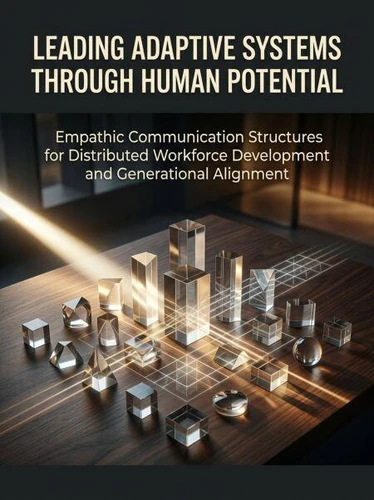
Leading Adaptive Systems Through Human Potential. Empathic Communication Structures for Distributed Workforce Development and Generational Alignment
Par :Formats :
Disponible dans votre compte client Decitre ou Furet du Nord dès validation de votre commande. Le format ePub est :
- Compatible avec une lecture sur My Vivlio (smartphone, tablette, ordinateur)
- Compatible avec une lecture sur liseuses Vivlio
- Pour les liseuses autres que Vivlio, vous devez utiliser le logiciel Adobe Digital Edition. Non compatible avec la lecture sur les liseuses Kindle, Remarkable et Sony
 , qui est-ce ?
Notre partenaire de plateforme de lecture numérique où vous retrouverez l'ensemble de vos ebooks gratuitement
Pour en savoir plus sur nos ebooks, consultez notre aide en ligne ici
C'est si simple ! Lisez votre ebook avec l'app Vivlio sur votre tablette, mobile ou ordinateur :

- Nombre de pages436
- FormatePub
- ISBN978-3-565-60230-8
- EAN9783565602308
- Date de parution30/07/2026
- Protection num.pas de protection
- Taille968 Ko
- Infos supplémentairesepub
- ÉditeurEmphaloz Publishing House
Résumé
Modern workforce structures demand leadership models that prioritize human development over command hierarchies. Organizations face generational fragmentation, remote coordination failures, and talent retention crises rooted in outdated management assumptions. The challenge is not motivational technique but structural redesign of how potential is identified, communicated, and scaled across distributed teams.
Empathic communication operates as an organizational system, not a soft skill.
When leadership frameworks embed developmental feedback loops, they create conditions for adaptive decision-making at every operational layer. Generational differences in work expectations require translation protocols that preserve strategic coherence while allowing localized autonomy. Human potential becomes a measurable input when leadership treats growth as infrastructure rather than aspiration. For organizations competing in knowledge economies, the shift from directive to developmental leadership determines long-term talent density and innovation capacity.
This approach reframes leadership as the design of conditions under which human capability compounds systematically.
When leadership frameworks embed developmental feedback loops, they create conditions for adaptive decision-making at every operational layer. Generational differences in work expectations require translation protocols that preserve strategic coherence while allowing localized autonomy. Human potential becomes a measurable input when leadership treats growth as infrastructure rather than aspiration. For organizations competing in knowledge economies, the shift from directive to developmental leadership determines long-term talent density and innovation capacity.
This approach reframes leadership as the design of conditions under which human capability compounds systematically.