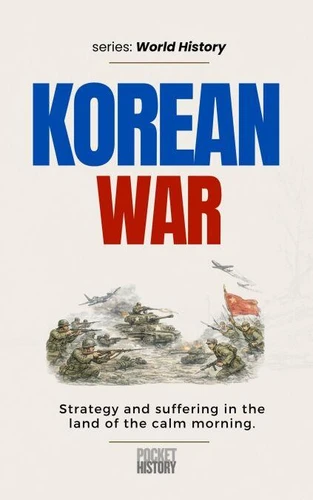
The Korean War (1950-1953) was one of the first major military confrontations of the Cold War and one of the most destructive conflicts of the twentieth century. Fought on the Korean Peninsula, the war began when North Korean forces crossed the 38th parallel and invaded South Korea, triggering an international crisis that rapidly drew in global powers. Within weeks, the conflict expanded into a multinational war.
The United Nations, led primarily by the United States, intervened to defend South Korea, while China entered the war in support of North Korea. Behind the scenes, the Soviet Union provided strategic backing, transforming the conflict into a critical battleground in the global struggle between communist and capitalist blocs. The war saw dramatic shifts in momentum. Early North Korean advances nearly conquered the entire peninsula, but a bold amphibious landing at Inchon turned the tide.
Soon afterward, massive Chinese intervention pushed United Nations forces back again, leading to years of brutal stalemate along the front lines. Despite enormous casualties and widespread devastation, the war ended not with a peace treaty but with an armistice signed in 1953. The Korean Peninsula remained divided along a heavily fortified demilitarized zone, creating one of the most enduring geopolitical tensions of the modern era.
This book explores the origins, battles, leaders, and global consequences of the Korean War, explaining how a regional conflict became a defining moment of the Cold War and shaped the political landscape of East Asia for decades to come.
The Korean War (1950-1953) was one of the first major military confrontations of the Cold War and one of the most destructive conflicts of the twentieth century. Fought on the Korean Peninsula, the war began when North Korean forces crossed the 38th parallel and invaded South Korea, triggering an international crisis that rapidly drew in global powers. Within weeks, the conflict expanded into a multinational war.
The United Nations, led primarily by the United States, intervened to defend South Korea, while China entered the war in support of North Korea. Behind the scenes, the Soviet Union provided strategic backing, transforming the conflict into a critical battleground in the global struggle between communist and capitalist blocs. The war saw dramatic shifts in momentum. Early North Korean advances nearly conquered the entire peninsula, but a bold amphibious landing at Inchon turned the tide.
Soon afterward, massive Chinese intervention pushed United Nations forces back again, leading to years of brutal stalemate along the front lines. Despite enormous casualties and widespread devastation, the war ended not with a peace treaty but with an armistice signed in 1953. The Korean Peninsula remained divided along a heavily fortified demilitarized zone, creating one of the most enduring geopolitical tensions of the modern era.
This book explores the origins, battles, leaders, and global consequences of the Korean War, explaining how a regional conflict became a defining moment of the Cold War and shaped the political landscape of East Asia for decades to come.

 , qui est-ce ?