
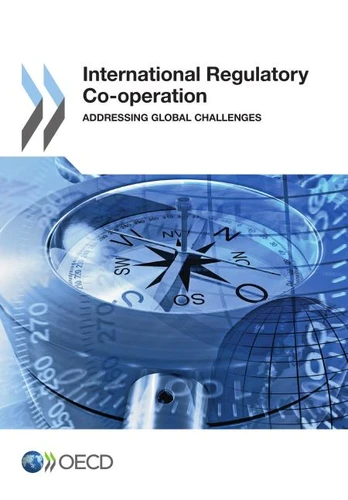
International regulatory co-operation-addressing global challenges
Par :Formats :
Disponible dans votre compte client Decitre ou Furet du Nord dès validation de votre commande. Le format PDF est :
- Compatible avec une lecture sur My Vivlio (smartphone, tablette, ordinateur)
- Compatible avec une lecture sur liseuses Vivlio
- Pour les liseuses autres que Vivlio, vous devez utiliser le logiciel Adobe Digital Edition. Non compatible avec la lecture sur les liseuses Kindle, Remarkable et Sony
 , qui est-ce ?
Notre partenaire de plateforme de lecture numérique où vous retrouverez l'ensemble de vos ebooks gratuitement
Pour en savoir plus sur nos ebooks, consultez notre aide en ligne ici
C'est si simple ! Lisez votre ebook avec l'app Vivlio sur votre tablette, mobile ou ordinateur :

- Nombre de pages156
- FormatPDF
- ISBN978-92-64-20046-3
- EAN9789264200463
- Date de parution24/04/2013
- Protection num.Digital Watermarking
- Taille3 Mo
- Infos supplémentairespdf
- ÉditeurOECD
Résumé
The world is becoming increasingly global. This raises important challenges for regulatory processes which still largely emanate from domestic jurisdictions. In order to eliminate unnecessary regulatory divergences and to address global challenges pertaining to systemic risks, the environment, and human health and safety, governments increasingly seek to better articulate regulations across borders and to ensure greater enforcement of rules and their application cross jurisdictions remain largely under-analysed.
This report gathers in a synthetic manner the knowledge and evidence available to date on the various mechanisms available to governments to promote regulatory co-operation, and their benefits and challenges. The review of evidence confirms the increased internationalisation of regulation, which takes place through a wide variety of mechanisms and multiple actors, and highlights a shift in the nature of IRC from complete 'harmonisation' of regulation to more flexible options - such as mutual recognition agreements.
Despite growing regulatory co-operation, however, decision making on IRC is not informed by a clear understanding of benefits costs and success factors of the diverse IRC options.
This report gathers in a synthetic manner the knowledge and evidence available to date on the various mechanisms available to governments to promote regulatory co-operation, and their benefits and challenges. The review of evidence confirms the increased internationalisation of regulation, which takes place through a wide variety of mechanisms and multiple actors, and highlights a shift in the nature of IRC from complete 'harmonisation' of regulation to more flexible options - such as mutual recognition agreements.
Despite growing regulatory co-operation, however, decision making on IRC is not informed by a clear understanding of benefits costs and success factors of the diverse IRC options.
A propos de OCDE


32,99 €

72,99 €

33,99 €

32,99 €
32,99 €

32,00 €

Tax compilance by design
E-book
16,00 €

16,00 €

19,00 €

16,00 €

25,00 €


23,00 €

Women in business 2014
E-book
31,00 €


27,00 €