A tech pioneer who balanced profit with principles in volatile markets, delivering self-help ethics training, business strategies for sustainable ventures, and histories of tech policy battles.
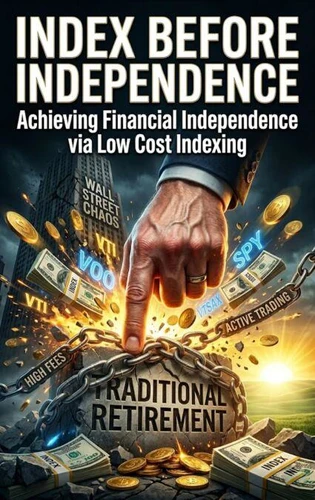
Index Before Independence. Achieving Financial Independence via Low Cost Indexing
Par :Formats :
Disponible dans votre compte client Decitre ou Furet du Nord dès validation de votre commande. Le format ePub est :
- Compatible avec une lecture sur My Vivlio (smartphone, tablette, ordinateur)
- Compatible avec une lecture sur liseuses Vivlio
- Pour les liseuses autres que Vivlio, vous devez utiliser le logiciel Adobe Digital Edition. Non compatible avec la lecture sur les liseuses Kindle, Remarkable et Sony
 , qui est-ce ?
Notre partenaire de plateforme de lecture numérique où vous retrouverez l'ensemble de vos ebooks gratuitement
Pour en savoir plus sur nos ebooks, consultez notre aide en ligne ici
C'est si simple ! Lisez votre ebook avec l'app Vivlio sur votre tablette, mobile ou ordinateur :

- Nombre de pages192
- FormatePub
- ISBN978-3-565-39666-5
- EAN9783565396665
- Date de parution09/04/2026
- Protection num.pas de protection
- Taille2 Mo
- Infos supplémentairesepub
- ÉditeurEmphaloz Publishing House
Résumé
Financial independence is not reserved for those with exceptional income, sophisticated portfolios, or access to elite financial advisors. It is, increasingly, the outcome of a deceptively simple discipline: consistent investment in low-cost index funds, sustained over time with structural patience and cost-conscious precision. The mathematics are unambiguous - a seemingly minor difference in annual fees of less than one percentage point can erode more than 27% of total returns over a thirty-year horizon.
Cost is not a footnote in the wealth-building equation; it is one of its most consequential variables. This book examines the structural logic behind low-cost indexing as a primary vehicle for financial independence, drawing on the foundational frameworks of the FIRE movement and the investment philosophy of thinkers such as JL Collins and John Bogle. It explores how passive index strategies - tracking broad market instruments such as the S&P 500, total stock market funds, and diversified bond indices - consistently outperform actively managed alternatives while compounding wealth with minimal friction.
Simplicity, in this context, is not a compromise; it is the strategy itself. Beyond the mechanics of fund selection and expense ratio analysis, this book addresses the behavioral discipline required to sustain an indexing strategy through market volatility, economic uncertainty, and the psychological temptation to intervene. Financial independence through low-cost indexing is not a passive outcome - it is an active commitment to a system designed to reward those who remain within it long enough for compounding to do its work.
Cost is not a footnote in the wealth-building equation; it is one of its most consequential variables. This book examines the structural logic behind low-cost indexing as a primary vehicle for financial independence, drawing on the foundational frameworks of the FIRE movement and the investment philosophy of thinkers such as JL Collins and John Bogle. It explores how passive index strategies - tracking broad market instruments such as the S&P 500, total stock market funds, and diversified bond indices - consistently outperform actively managed alternatives while compounding wealth with minimal friction.
Simplicity, in this context, is not a compromise; it is the strategy itself. Beyond the mechanics of fund selection and expense ratio analysis, this book addresses the behavioral discipline required to sustain an indexing strategy through market volatility, economic uncertainty, and the psychological temptation to intervene. Financial independence through low-cost indexing is not a passive outcome - it is an active commitment to a system designed to reward those who remain within it long enough for compounding to do its work.