SOLDES
Jusqu'à -70% sur une sélection d'articles*

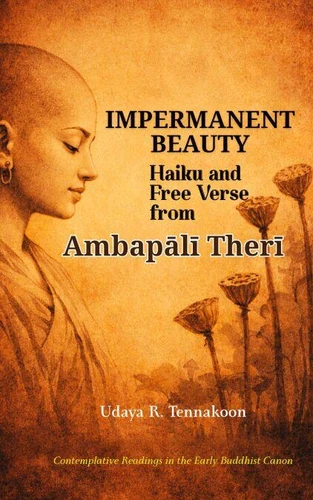
Impermanent Beauty: Haiku and Free Verse from Ambapālī Therī. Therigatha Haiku and Verse, #2
Par :Formats :
Disponible dans votre compte client Decitre ou Furet du Nord dès validation de votre commande. Le format ePub est :
- Compatible avec une lecture sur My Vivlio (smartphone, tablette, ordinateur)
- Compatible avec une lecture sur liseuses Vivlio
- Pour les liseuses autres que Vivlio, vous devez utiliser le logiciel Adobe Digital Edition. Non compatible avec la lecture sur les liseuses Kindle, Remarkable et Sony
 , qui est-ce ?
Notre partenaire de plateforme de lecture numérique où vous retrouverez l'ensemble de vos ebooks gratuitement
Pour en savoir plus sur nos ebooks, consultez notre aide en ligne ici
C'est si simple ! Lisez votre ebook avec l'app Vivlio sur votre tablette, mobile ou ordinateur :

- FormatePub
- ISBN8233211362
- EAN9798233211362
- Date de parution02/02/2026
- Protection num.pas de protection
- Infos supplémentairesepub
- ÉditeurLinda Balsamo
Résumé
Impermanent Beauty: Haiku and Free Verse from Ambapali Theri offers a carefully considered, verse-by-verse adaptation of the Therigatha, the canonical collection of poems composed by early Buddhist nuns. This volume focuses on verses 252-270, attributed to Ambapali Theri, one of the most renowned figures in early Buddhism. Her poetry engages deeply with the body as a site of insight, enumerating features of physical form-hair, eyes, teeth, limbs-through the interrelated lenses of aging (jara), impermanence (anicca), and unsatisfactoriness (dukkha).
The English renderings employ a mixed formal approach, alternating between strict 5-7-5 haiku and tightly disciplined free verse, calibrated to the rhythm, density, and rhetorical force of the original Pali. Each poem is presented as a discrete contemplative unit, encouraging reflective reading that mirrors the enumerative descent and meditative attention of the source texts. Typographical and editorial conventions signal formal variation without distracting from the work's doctrinal and literary intentions: haiku are marked in small caps with generous line spacing, while free verse retains a controlled, unobtrusive layout.
This adaptation is grounded in careful philological practice. Pali sources are drawn from the Sinhala and Pali Tipi?aka and cross-checked with contemporary English translations, including Bhikkhu Sujato's work via SuttaCentral. Line-by-line crosswalks, footnotes, and formal audits in the appendices provide transparency and reproducibility, allowing readers and scholars to trace editorial decisions, semantic nuances, and formal correspondence.
The work thus bridges scholarly rigor and contemplative practice, offering both textual insight and experiential engagement with early Buddhist poetics. Ambapali Theri herself is a figure of historical and spiritual significance. Historically a celebrated courtesan of Vesali, she exercised social and moral agency within her urban milieu before renouncing worldly life, entering the monastic Sa?gha, and attaining arahantship.
Her poetry does not erase her past but transforms intimate experience of beauty, desire, and the body into disciplined reflection on impermanence and liberation. In this sense, the volume embodies a dialogue across time: the voice of an awakened elder is rendered into English while preserving both doctrinal integrity and aesthetic clarity. Designed for readers at the intersection of scholarship, meditation, and literary appreciation, Impermanent Beauty invites engagement with the body, the self, and the subtle work of attention.
It is suitable for students of early Buddhism, comparative religion, literary studies, and contemplative practice alike, providing a model of how close philological reading can coexist with reflective, meditative engagement.
The English renderings employ a mixed formal approach, alternating between strict 5-7-5 haiku and tightly disciplined free verse, calibrated to the rhythm, density, and rhetorical force of the original Pali. Each poem is presented as a discrete contemplative unit, encouraging reflective reading that mirrors the enumerative descent and meditative attention of the source texts. Typographical and editorial conventions signal formal variation without distracting from the work's doctrinal and literary intentions: haiku are marked in small caps with generous line spacing, while free verse retains a controlled, unobtrusive layout.
This adaptation is grounded in careful philological practice. Pali sources are drawn from the Sinhala and Pali Tipi?aka and cross-checked with contemporary English translations, including Bhikkhu Sujato's work via SuttaCentral. Line-by-line crosswalks, footnotes, and formal audits in the appendices provide transparency and reproducibility, allowing readers and scholars to trace editorial decisions, semantic nuances, and formal correspondence.
The work thus bridges scholarly rigor and contemplative practice, offering both textual insight and experiential engagement with early Buddhist poetics. Ambapali Theri herself is a figure of historical and spiritual significance. Historically a celebrated courtesan of Vesali, she exercised social and moral agency within her urban milieu before renouncing worldly life, entering the monastic Sa?gha, and attaining arahantship.
Her poetry does not erase her past but transforms intimate experience of beauty, desire, and the body into disciplined reflection on impermanence and liberation. In this sense, the volume embodies a dialogue across time: the voice of an awakened elder is rendered into English while preserving both doctrinal integrity and aesthetic clarity. Designed for readers at the intersection of scholarship, meditation, and literary appreciation, Impermanent Beauty invites engagement with the body, the self, and the subtle work of attention.
It is suitable for students of early Buddhism, comparative religion, literary studies, and contemplative practice alike, providing a model of how close philological reading can coexist with reflective, meditative engagement.
A propos de Udaya R. Tennakoon

5,99 €



6,99 €

5,49 €

6,49 €
5,49 €

7,99 €