
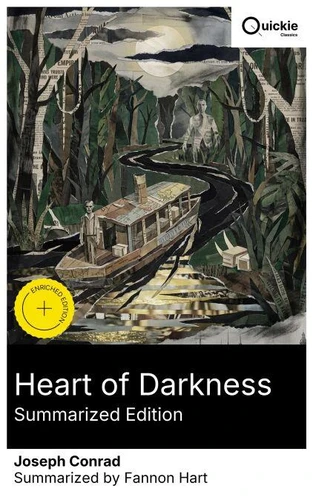
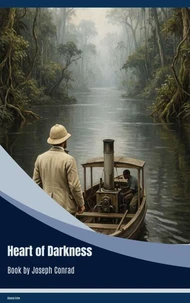
Heart of Darkness (Summarized Edition). Enriched edition. A Congo River journey into imperialism's shadow—psychological descent, impressionistic and framed, from a riverboat captain to an ivory myth.
Par : ,Formats :
Disponible dans votre compte client Decitre ou Furet du Nord dès validation de votre commande. Le format ePub est :
- Compatible avec une lecture sur My Vivlio (smartphone, tablette, ordinateur)
- Compatible avec une lecture sur liseuses Vivlio
- Pour les liseuses autres que Vivlio, vous devez utiliser le logiciel Adobe Digital Edition. Non compatible avec la lecture sur les liseuses Kindle, Remarkable et Sony
 , qui est-ce ?
Notre partenaire de plateforme de lecture numérique où vous retrouverez l'ensemble de vos ebooks gratuitement
Pour en savoir plus sur nos ebooks, consultez notre aide en ligne ici
C'est si simple ! Lisez votre ebook avec l'app Vivlio sur votre tablette, mobile ou ordinateur :

- Nombre de pages70
- FormatePub
- ISBN859-65--4787511-6
- EAN8596547875116
- Date de parution12/01/2026
- Protection num.Digital Watermarking
- Taille819 Ko
- Infos supplémentairesepub
- ÉditeurQUICKIE CLASSICS
Résumé
Heart of Darkness, Conrad's 1899 novella, unfurls via a frame narrative on the Thames as Marlow recounts his journey up the Congo to find the enigmatic agent Kurtz. Its impressionistic prose, shifting perspectives, and recursive imagery cultivate ambiguity, making readers complicit interpreters of imperial horror. The river's serpentine course, chiaroscuro motifs, and elliptical revelations exemplify Conrad's proto-modernist technique, while the text's engagement with the Belgian Congo exposes the moral bankruptcy of late Victorian imperialism and the fin-de-siecle crisis of faith.
Born Jozef Teodor Konrad Korzeniowski in partitioned Poland, Conrad spent two decades at sea before becoming a novelist in English, his third language. His 1890 service in the Congo Free State (beset by illness, bureaucratic chaos, and the spectacle of extractive violence) supplied the tale's factual armature and psychic charge. The expatriate's vantage, polyglot sensibility, and nautical apprenticeship shaped the novella's ethical skepticism and navigational metaphors.
Recommended to readers of modernism, narrative theory, and postcolonial critique, Heart of Darkness rewards close, critical reading, alongside its contested reception, from early admirers to Achebe's indictment. Assign it for seminars or revisit it privately to test how form, voice, and silence map the darkest currents of power. Quickie Classics summarizes timeless works with precision, preserving the author's voice and keeping the prose clear, fast, and readable-distilled, never diluted.
Enriched Edition extras: Introduction · Synopsis · Historical Context · Author Biography · Brief Analysis · 4 Reflection Q&As · Editorial Footnotes.
Born Jozef Teodor Konrad Korzeniowski in partitioned Poland, Conrad spent two decades at sea before becoming a novelist in English, his third language. His 1890 service in the Congo Free State (beset by illness, bureaucratic chaos, and the spectacle of extractive violence) supplied the tale's factual armature and psychic charge. The expatriate's vantage, polyglot sensibility, and nautical apprenticeship shaped the novella's ethical skepticism and navigational metaphors.
Recommended to readers of modernism, narrative theory, and postcolonial critique, Heart of Darkness rewards close, critical reading, alongside its contested reception, from early admirers to Achebe's indictment. Assign it for seminars or revisit it privately to test how form, voice, and silence map the darkest currents of power. Quickie Classics summarizes timeless works with precision, preserving the author's voice and keeping the prose clear, fast, and readable-distilled, never diluted.
Enriched Edition extras: Introduction · Synopsis · Historical Context · Author Biography · Brief Analysis · 4 Reflection Q&As · Editorial Footnotes.
A propos de JOSEPH CONRAD


Under Western Eyes
E-book
4,99 €

The Secret Sharer
E-book
3,99 €

4,99 €
0,99 €
Lord Jim
E-book
0,99 €
Heart of Darkness
E-book
0,99 €
Tales of Unrest
E-book
3,99 €
0,99 €
13,99 €


Entre terre et mer
E-book
1,99 €
En marge des marées
E-book
1,99 €
Das Herz der Finsternis
E-book
0,49 €