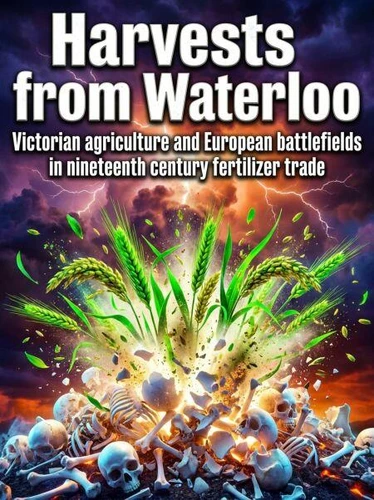
Harvests from Waterloo. Victorian agriculture and European battlefields in nineteenth century fertilizer trade
Par :Formats :
Disponible dans votre compte client Decitre ou Furet du Nord dès validation de votre commande. Le format ePub est :
- Compatible avec une lecture sur My Vivlio (smartphone, tablette, ordinateur)
- Compatible avec une lecture sur liseuses Vivlio
- Pour les liseuses autres que Vivlio, vous devez utiliser le logiciel Adobe Digital Edition. Non compatible avec la lecture sur les liseuses Kindle, Remarkable et Sony
 , qui est-ce ?
Notre partenaire de plateforme de lecture numérique où vous retrouverez l'ensemble de vos ebooks gratuitement
Pour en savoir plus sur nos ebooks, consultez notre aide en ligne ici
C'est si simple ! Lisez votre ebook avec l'app Vivlio sur votre tablette, mobile ou ordinateur :

- Nombre de pages210
- FormatePub
- ISBN978-3-565-46461-6
- EAN9783565464616
- Date de parution28/05/2026
- Protection num.pas de protection
- Taille1 Mo
- Infos supplémentairesepub
- ÉditeurEmphaloz Publishing House
Résumé
Fields across industrial Britain flourished through a trade few farmers ever witnessed. Beneath rising crop yields lay the remains of Europe's dead. During the nineteenth century, human bones from Waterloo and ancient burial grounds entered the expanding fertilizer economy, binding agricultural progress to the physical residue of war.
As British farming intensified, phosphate shortages transformed bones into strategic commodities.
Merchants purchased skeletal remains from abandoned battlefields, neglected cemeteries, and archaeological sites across continental Europe. Crushed into fertilizer for industrial agriculture, these shipments moved through ports and factories alongside coal, grain, and iron. Victorian agricultural journals celebrated scientific efficiency while rarely confronting the moral cost hidden within the fertilizer trade.
The circulation of human remains through commodity markets revealed how industrial capitalism absorbed even the dead into systems of production. The book follows customs records, fertilizer company reports, and nineteenth century trade debates to reconstruct a forgotten economic network. It traces how European warfare, imperial transport routes, and modern farming became interconnected through phosphates extracted from human history itself. Beyond Waterloo, the story exposes a broader European transformation in which memory surrendered to industrial necessity, and the boundaries between progress and desecration quietly collapsed.
Merchants purchased skeletal remains from abandoned battlefields, neglected cemeteries, and archaeological sites across continental Europe. Crushed into fertilizer for industrial agriculture, these shipments moved through ports and factories alongside coal, grain, and iron. Victorian agricultural journals celebrated scientific efficiency while rarely confronting the moral cost hidden within the fertilizer trade.
The circulation of human remains through commodity markets revealed how industrial capitalism absorbed even the dead into systems of production. The book follows customs records, fertilizer company reports, and nineteenth century trade debates to reconstruct a forgotten economic network. It traces how European warfare, imperial transport routes, and modern farming became interconnected through phosphates extracted from human history itself. Beyond Waterloo, the story exposes a broader European transformation in which memory surrendered to industrial necessity, and the boundaries between progress and desecration quietly collapsed.