Nouveauté
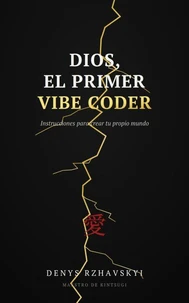
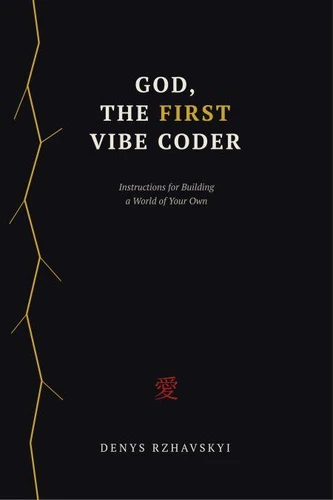
GOD, THE FIRST VIBE CODER. Instructions for Building a World of Your Own
Par :Formats :
Disponible dans votre compte client Decitre ou Furet du Nord dès validation de votre commande. Le format ePub est :
- Compatible avec une lecture sur My Vivlio (smartphone, tablette, ordinateur)
- Compatible avec une lecture sur liseuses Vivlio
- Pour les liseuses autres que Vivlio, vous devez utiliser le logiciel Adobe Digital Edition. Non compatible avec la lecture sur les liseuses Kindle, Remarkable et Sony
 , qui est-ce ?
Notre partenaire de plateforme de lecture numérique où vous retrouverez l'ensemble de vos ebooks gratuitement
Pour en savoir plus sur nos ebooks, consultez notre aide en ligne ici
C'est si simple ! Lisez votre ebook avec l'app Vivlio sur votre tablette, mobile ou ordinateur :

- FormatePub
- ISBN8235406827
- EAN9798235406827
- Date de parution18/07/2026
- Protection num.pas de protection
- Infos supplémentairesepub
- ÉditeurIoakim Ioakim
Résumé
On a Sunday in February 2025, an engineer confessed that he had stopped writing code. He simply speaks his wishes aloud, and the machine obeys. Strip away the laptop and you are left with a text three and a half thousand years old: someone utters a desire, an invisible executor turns it into reality, and no one understands the mechanism. We have a name for this genre. It is called creation through the word, and it may be the most durable idea in the history of human imagination.
For the first time, it is technically real. God, the First Vibe Coder is a field guide for a generation that has been handed something every fairy tale warned about: a wish-granting machine that never swims back to the sea. It does not moralize. It does not tire. It fulfills everything - and the next request, and the one after that - and it will never take anything back. The old danger was to be left with nothing.
The new one is to receive everything and discover you asked for the wrong things. Denys Rzhavskyi - artist, musician, and kintsugi master - reads the operating manual we forgot how to use. Moving from the Egyptian Shabaka Stone to Leibniz's binary code, from Grace Hopper's first compiler to the modern prompt, from the Vedic priest who mispronounced a single syllable to the fisherman's wife beside her broken trough, he shows that prayer, mantra, and prompt are not three things but one genre in three costumes - and that humanity spent millennia learning to address an inscrutable executor with precision.
That knowledge is suddenly needed again. Along the way the book asks the questions the courses skip: Who actually configures the reality you wake up in - and how to take back the pen. Why the quality of your life is converging on the quality of your requests. How a crack, honestly shown, becomes stronger than unbroken wholeness - the logic of kintsugi applied to code, grief, and a life. What an hour of your genuine attention is worth, and to whom you give it.
What remains of a person in a world where their data will outlive them. How to assemble all of it into seven days of creation - a working practice, from separating signal from noise to the discipline of the pause. This is not a book about tools, and not a book of optimism about technology. It is a book about self-knowledge disguised as a book about technique - as, the author argues, the entire history of prayer has always been.
It is rigorous where it can be checked and honest where it cannot: the author debunks more myths than he builds, including his own, and ends not on a mountaintop but on a level platform with a view in every direction. For readers of Yuval Noah Harari, James Carse, and Kevin Kelly; for anyone who has ever received exactly what they asked for and none of what they wanted; for makers, writers, believers, and skeptics standing at the same blinking cursor.
The fish is already speaking to everyone. Even silence has become a request - it will simply be fulfilled by someone else, and the world you wake up in tomorrow will have been configured without you. So we will have to learn to ask. Your world begins with the next word.
For the first time, it is technically real. God, the First Vibe Coder is a field guide for a generation that has been handed something every fairy tale warned about: a wish-granting machine that never swims back to the sea. It does not moralize. It does not tire. It fulfills everything - and the next request, and the one after that - and it will never take anything back. The old danger was to be left with nothing.
The new one is to receive everything and discover you asked for the wrong things. Denys Rzhavskyi - artist, musician, and kintsugi master - reads the operating manual we forgot how to use. Moving from the Egyptian Shabaka Stone to Leibniz's binary code, from Grace Hopper's first compiler to the modern prompt, from the Vedic priest who mispronounced a single syllable to the fisherman's wife beside her broken trough, he shows that prayer, mantra, and prompt are not three things but one genre in three costumes - and that humanity spent millennia learning to address an inscrutable executor with precision.
That knowledge is suddenly needed again. Along the way the book asks the questions the courses skip: Who actually configures the reality you wake up in - and how to take back the pen. Why the quality of your life is converging on the quality of your requests. How a crack, honestly shown, becomes stronger than unbroken wholeness - the logic of kintsugi applied to code, grief, and a life. What an hour of your genuine attention is worth, and to whom you give it.
What remains of a person in a world where their data will outlive them. How to assemble all of it into seven days of creation - a working practice, from separating signal from noise to the discipline of the pause. This is not a book about tools, and not a book of optimism about technology. It is a book about self-knowledge disguised as a book about technique - as, the author argues, the entire history of prayer has always been.
It is rigorous where it can be checked and honest where it cannot: the author debunks more myths than he builds, including his own, and ends not on a mountaintop but on a level platform with a view in every direction. For readers of Yuval Noah Harari, James Carse, and Kevin Kelly; for anyone who has ever received exactly what they asked for and none of what they wanted; for makers, writers, believers, and skeptics standing at the same blinking cursor.
The fish is already speaking to everyone. Even silence has become a request - it will simply be fulfilled by someone else, and the world you wake up in tomorrow will have been configured without you. So we will have to learn to ask. Your world begins with the next word.