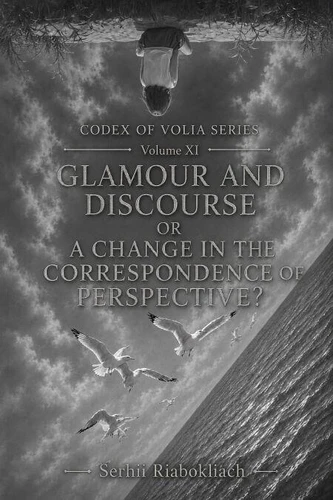
What happens between "I AM" and the next step?Why do we so easily mistake a photograph of ourselves for ourselves, a transmitted focus for our own obvious truth, and a convenient perspective for Reality?Volume XI of Codex of Volia explores not merely what a person thinks, but where they are looking from, what enters focus, and how what is seen becomes action. Here, glamour is not glitter or luxury.
It is the technology of making an image desirable. Discourse is not merely a way of speaking; it is a frame that helps determine what appears normal, correct, and obvious. STOPE is a tiny pause that does not command, "think differently." It says something much more modest: do not rush to think the same way again. The book follows the path from perspective and focus through state, Intent, Volia, Kletos, action, and the next causal configuration.
It tests the difference between an Architect and a Usurper not by noble declarations, but by the trace an interaction leaves in another person's field of possibility. Most importantly, this book does not ask to be believed. It begins with the words "Do not believe even this book" and turns its own measure upon the author, the Codex of Volia, and every formula that has become too beautiful to test.
Not belief. Not a final answer. A workshop.
What happens between "I AM" and the next step?Why do we so easily mistake a photograph of ourselves for ourselves, a transmitted focus for our own obvious truth, and a convenient perspective for Reality?Volume XI of Codex of Volia explores not merely what a person thinks, but where they are looking from, what enters focus, and how what is seen becomes action. Here, glamour is not glitter or luxury.
It is the technology of making an image desirable. Discourse is not merely a way of speaking; it is a frame that helps determine what appears normal, correct, and obvious. STOPE is a tiny pause that does not command, "think differently." It says something much more modest: do not rush to think the same way again. The book follows the path from perspective and focus through state, Intent, Volia, Kletos, action, and the next causal configuration.
It tests the difference between an Architect and a Usurper not by noble declarations, but by the trace an interaction leaves in another person's field of possibility. Most importantly, this book does not ask to be believed. It begins with the words "Do not believe even this book" and turns its own measure upon the author, the Codex of Volia, and every formula that has become too beautiful to test.
Not belief. Not a final answer. A workshop.

 , qui est-ce ?