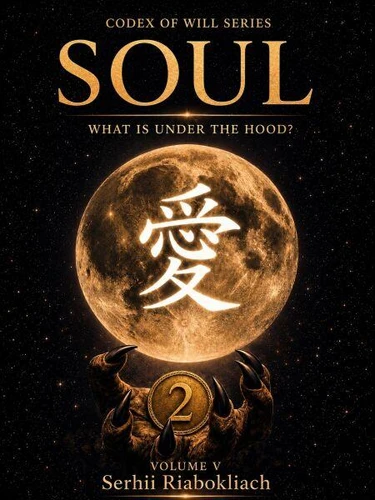
Soul. What Is Under the Hood? is the fifth volume in the Codex of Will series - an authorial philosophical-metaphorical exploration of life, Consciousness, Soul, body, Lineage, Volia, death, Nature, and responsibility. This book does not offer comfort for the sake of comfort. It does not sell immortality as a reward for obedience. It does not turn the Soul into a religious idol, a mystical decoration, or a poetic word that cannot be touched by thought.
Instead, it lifts the hood and asks a direct question: what if the Soul is not a symbol for worship, but a working architecture of passage?Within this authorial model, the Soul is understood not as personality, not as morality, not as a set of emotions, and not as a "higher self" that saves a person instead of their own Consciousness. The Soul conducts. It gives passage, supplies Volia, holds the possibility of life moving through form, and creates the conditions in which Consciousness can choose, grow, distort, betray, or become clearer.
The book separates three things that are too often thrown into one foggy pile: Soul, Consciousness, and body. The body is the dense form of passage and the place where consequence becomes visible. Consciousness chooses the route and carries responsibility. The Soul supplies the living possibility of passage. Only after this distinction becomes clear can the book move further - into Lineage, illness, birth, the first breath, sleep, death, egregores, Nature as a living network, and the difficult question of what people have tried to name with the word "God."This is not a religious doctrine.
It is not therapy, medical guidance, psychology, or a promise of transformation. It is not a system of worship and not a new spiritual authority. It is a philosophical map written in the language of the Codex of Will - sharp, metaphorical, technical, and deeply focused on responsibility. At the center of the volume stands one hard formula: the Soul does not save. The Soul conducts. And Consciousness must walk.
If you are looking for soft reassurance, this book may feel too direct. If you are looking for a way to think about the Soul without handing it over to dogma, superstition, sentimentality, or dead materialism, this volume opens the hood and begins the work.
Soul. What Is Under the Hood? is the fifth volume in the Codex of Will series - an authorial philosophical-metaphorical exploration of life, Consciousness, Soul, body, Lineage, Volia, death, Nature, and responsibility. This book does not offer comfort for the sake of comfort. It does not sell immortality as a reward for obedience. It does not turn the Soul into a religious idol, a mystical decoration, or a poetic word that cannot be touched by thought.
Instead, it lifts the hood and asks a direct question: what if the Soul is not a symbol for worship, but a working architecture of passage?Within this authorial model, the Soul is understood not as personality, not as morality, not as a set of emotions, and not as a "higher self" that saves a person instead of their own Consciousness. The Soul conducts. It gives passage, supplies Volia, holds the possibility of life moving through form, and creates the conditions in which Consciousness can choose, grow, distort, betray, or become clearer.
The book separates three things that are too often thrown into one foggy pile: Soul, Consciousness, and body. The body is the dense form of passage and the place where consequence becomes visible. Consciousness chooses the route and carries responsibility. The Soul supplies the living possibility of passage. Only after this distinction becomes clear can the book move further - into Lineage, illness, birth, the first breath, sleep, death, egregores, Nature as a living network, and the difficult question of what people have tried to name with the word "God."This is not a religious doctrine.
It is not therapy, medical guidance, psychology, or a promise of transformation. It is not a system of worship and not a new spiritual authority. It is a philosophical map written in the language of the Codex of Will - sharp, metaphorical, technical, and deeply focused on responsibility. At the center of the volume stands one hard formula: the Soul does not save. The Soul conducts. And Consciousness must walk.
If you are looking for soft reassurance, this book may feel too direct. If you are looking for a way to think about the Soul without handing it over to dogma, superstition, sentimentality, or dead materialism, this volume opens the hood and begins the work.

 , qui est-ce ?