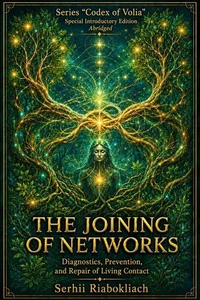
Closing of Networks is not a book about guilt. It is a workshop of living responsibility. For centuries, religion tried to stop chaotic intimate contact by shouting one word: sin. Modern culture often answers with another phrase: nothing happened. This book rejects both fogs. It does not turn the body into an enemy. It does not shame desire. It does not build a new moral cage. Instead, it opens the hood and asks a harder question: what actually passes through a human being when two living networks come into deep contact?In the language of the Codex of Will, intimate contact is not "just the body." A whole human being enters it: body, Consciousness, subconsciousness, Ego, Lineage, Soul, Volia, boundary, and responsibility.
The key question is not only what happened, but who was driving the closing: Consciousness, Kohannia, Ego, loneliness, trauma, fear, another person's will, or an inherited loop?This volume introduces a precise diagnosis: chaotic closing of lineage-information networks without awareness, boundary, Volia, and responsibility. It shows why a contact can create a Living MIZH - a real third field between two sovereign beings - or an Excess Loop that continues to pull energy, distort trust, weaken boundaries, and pass unresolved patterns into the future.
This is not a religious sermon, not a therapy manual, and not a manual of prohibition. It is an authorial philosophical-metaphorical system for seeing the mechanics of living contact: how shame fails to repair, why forgiveness without truth may only refinance a debt, why the body is the service vehicle of Lineage, and why responsibility belongs equally to men and women because Consciousness has no sex.
The repair formula is simple, but not easy:See with Consciousness. Name with Sincerity. Stop the transmission with Volia. Repair with Kohannia. Closing of Networks is a book for readers who feel that humanity's deepest crises are not only political, economic, or psychological, but also hidden in the way people enter contact without understanding what they open, what they transmit, and what their children and grandchildren may carry forward.
This book does not ask you to feel guilty. It asks you to turn on the light in the workshop.
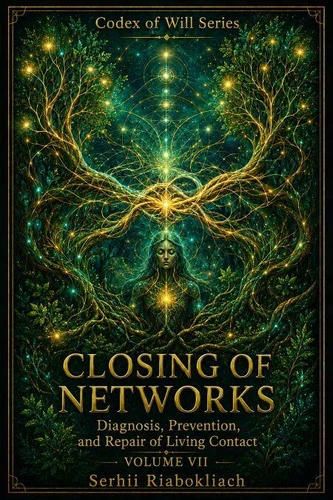
Closing of Networks is not a book about guilt. It is a workshop of living responsibility. For centuries, religion tried to stop chaotic intimate contact by shouting one word: sin. Modern culture often answers with another phrase: nothing happened. This book rejects both fogs. It does not turn the body into an enemy. It does not shame desire. It does not build a new moral cage. Instead, it opens the hood and asks a harder question: what actually passes through a human being when two living networks come into deep contact?In the language of the Codex of Will, intimate contact is not "just the body." A whole human being enters it: body, Consciousness, subconsciousness, Ego, Lineage, Soul, Volia, boundary, and responsibility.
The key question is not only what happened, but who was driving the closing: Consciousness, Kohannia, Ego, loneliness, trauma, fear, another person's will, or an inherited loop?This volume introduces a precise diagnosis: chaotic closing of lineage-information networks without awareness, boundary, Volia, and responsibility. It shows why a contact can create a Living MIZH - a real third field between two sovereign beings - or an Excess Loop that continues to pull energy, distort trust, weaken boundaries, and pass unresolved patterns into the future.
This is not a religious sermon, not a therapy manual, and not a manual of prohibition. It is an authorial philosophical-metaphorical system for seeing the mechanics of living contact: how shame fails to repair, why forgiveness without truth may only refinance a debt, why the body is the service vehicle of Lineage, and why responsibility belongs equally to men and women because Consciousness has no sex.
The repair formula is simple, but not easy:See with Consciousness. Name with Sincerity. Stop the transmission with Volia. Repair with Kohannia. Closing of Networks is a book for readers who feel that humanity's deepest crises are not only political, economic, or psychological, but also hidden in the way people enter contact without understanding what they open, what they transmit, and what their children and grandchildren may carry forward.
This book does not ask you to feel guilty. It asks you to turn on the light in the workshop.

 , qui est-ce ?