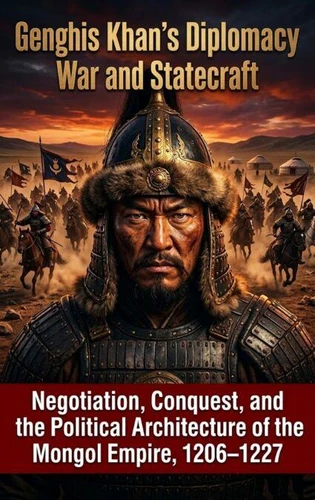
Genghis Khan's Diplomacy: War and Statecraft. Negotiation, Conquest, and the Political Architecture of the Mongol Empire, 1206–1227
Par :Formats :
Disponible dans votre compte client Decitre ou Furet du Nord dès validation de votre commande. Le format ePub est :
- Compatible avec une lecture sur My Vivlio (smartphone, tablette, ordinateur)
- Compatible avec une lecture sur liseuses Vivlio
- Pour les liseuses autres que Vivlio, vous devez utiliser le logiciel Adobe Digital Edition. Non compatible avec la lecture sur les liseuses Kindle, Remarkable et Sony
 , qui est-ce ?
Notre partenaire de plateforme de lecture numérique où vous retrouverez l'ensemble de vos ebooks gratuitement
Pour en savoir plus sur nos ebooks, consultez notre aide en ligne ici
C'est si simple ! Lisez votre ebook avec l'app Vivlio sur votre tablette, mobile ou ordinateur :

- Nombre de pages206
- FormatePub
- ISBN978-3-565-32496-5
- EAN9783565324965
- Date de parution14/03/2026
- Protection num.pas de protection
- Taille2 Mo
- Infos supplémentairesepub
- ÉditeurEmphaloz Publishing House
Résumé
Genghis Khan's reputation rests almost entirely on destruction - the cities reduced to rubble, the populations annihilated, the civilizations interrupted. What that reputation obscures is the sophisticated diplomatic apparatus through which the Mongol Empire was actually constructed and sustained. Before armies moved, envoys arrived. Genghis Khan offered submission, trade access, and administrative continuity to those who capitulated, and reserved annihilation for those who killed his ambassadors or refused his terms.
Diplomacy was not the alternative to Mongol warfare - it was its essential precondition. This book reconstructs Mongol statecraft through Persian, Chinese, and Armenian chronicles, the Secret History of the Mongols, and four decades of Central Asian archaeological scholarship. It examines the diplomatic infrastructure Genghis Khan built: the yam courier network that connected an empire spanning four thousand kilometers, the multilingual secretariat staffed by conquered administrators, the deliberate policy of religious tolerance as a tool of political consolidation, and the carefully calibrated use of terror as a negotiating instrument. The narrative traces how Genghis Khan transformed a confederation of steppe tribes into a functioning imperial administration - recruiting Uyghur scribes, Chinese engineers, Persian financiers, and Khitan administrators into a bureaucratic system that outlasted its founder by over a century.
It also examines where Mongol diplomacy failed: the miscalculations that triggered the Khwarazmian campaign, the limits of steppe political culture when applied to sedentary agricultural societies, and the gradual fragmentation of the empire into competing successor states. A rigorously sourced account of the Mongol Empire as a political and diplomatic achievement - not only a military one.
Diplomacy was not the alternative to Mongol warfare - it was its essential precondition. This book reconstructs Mongol statecraft through Persian, Chinese, and Armenian chronicles, the Secret History of the Mongols, and four decades of Central Asian archaeological scholarship. It examines the diplomatic infrastructure Genghis Khan built: the yam courier network that connected an empire spanning four thousand kilometers, the multilingual secretariat staffed by conquered administrators, the deliberate policy of religious tolerance as a tool of political consolidation, and the carefully calibrated use of terror as a negotiating instrument. The narrative traces how Genghis Khan transformed a confederation of steppe tribes into a functioning imperial administration - recruiting Uyghur scribes, Chinese engineers, Persian financiers, and Khitan administrators into a bureaucratic system that outlasted its founder by over a century.
It also examines where Mongol diplomacy failed: the miscalculations that triggered the Khwarazmian campaign, the limits of steppe political culture when applied to sedentary agricultural societies, and the gradual fragmentation of the empire into competing successor states. A rigorously sourced account of the Mongol Empire as a political and diplomatic achievement - not only a military one.