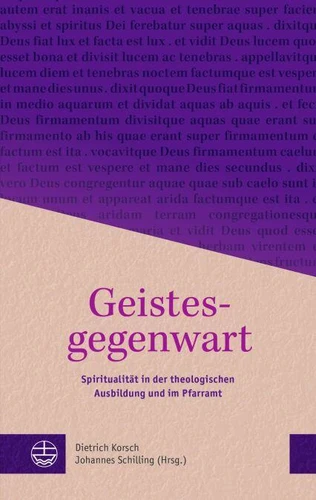
Geistesgegenwart. Spiritualität in der theologischen Ausbildung und im Pfarramt
Par : ,Formats :
Disponible dans votre compte client Decitre ou Furet du Nord dès validation de votre commande. Le format PDF est :
- Compatible avec une lecture sur My Vivlio (smartphone, tablette, ordinateur)
- Compatible avec une lecture sur liseuses Vivlio
- Pour les liseuses autres que Vivlio, vous devez utiliser le logiciel Adobe Digital Edition. Non compatible avec la lecture sur les liseuses Kindle, Remarkable et Sony
 , qui est-ce ?
Notre partenaire de plateforme de lecture numérique où vous retrouverez l'ensemble de vos ebooks gratuitement
Pour en savoir plus sur nos ebooks, consultez notre aide en ligne ici
C'est si simple ! Lisez votre ebook avec l'app Vivlio sur votre tablette, mobile ou ordinateur :

- Nombre de pages190
- FormatPDF
- ISBN978-3-374-07098-5
- EAN9783374070985
- Date de parution20/09/2022
- Protection num.Digital Watermarking
- Taille1 Mo
- Infos supplémentairespdf
- ÉditeurEvangelische Verlagsanstalt
Résumé
»Spiritualität« ist ein Schlüsselwort in religiösen Diskursen geworden. Allerdings ist es weitgehend unbestimmt und beliebig, was darunter verstanden werden soll. Darum ist es in Theologie und Kirche auch unentschieden, wie mit dem Phänomen umzugehen ist. Das vorliegende Buch versteht Spiritualität von der Gegenwart des Geistes Gottes her, wie er im Menschen wirkt - und ihn in seiner individuellen Menschlichkeit bestimmt.
Dadurch wird der Begriff genau bestimmt und es tritt seine Verwandtschaft mit dem zutage, was in der evangelischen Tradition Frömmigkeit genannt wird. Man kann dann erkennen: Spiritualität ist in der theologischen Praxis immer schon da; darum kann sie auch gebildet werden. Wie das in der theologischen Ausbildung und in der pfarramtlichen Praxis geschehen kann, zeigen die empirischen, historischen und systematischen Beiträge dieses Buches aus der Sicht von Kirchenleitung und Universitätstheologie. Mit Beiträgen von Ilsabe Alpermann, Martin Evang, Bernhard Dressler, Jürgen Kampmann, Dietrich Korsch, Kristina Kühnbaum-Schmidt, Johannes Schilling, Adelheid Ruck-Schröder und Regina Sommer. [Presence of Mind.
Spirituality in Theological Education and Ministry] "Spirituality" has become a key word in religious discourses. Yet it is largely unclear and arbitrary how one should understand it. Thus it is undecided also in theology and church how to deal with the phenomenon. The present book understands spirituality in terms of the presence of God's spirit as it works in human beings - and determines them in their individual humanity.
In this way, the concept is precisely defined, while making visible the concept's relationship to what is called piety in the Protestant tradition. Thus one can see that spirituality is always already present in theological practice; that is why it can also be formed. How this can occur in theological education and in pastoral practice is shown in the empirical, historical and systematic contributions of this book from the perspective of church leadership and university theology.
Dadurch wird der Begriff genau bestimmt und es tritt seine Verwandtschaft mit dem zutage, was in der evangelischen Tradition Frömmigkeit genannt wird. Man kann dann erkennen: Spiritualität ist in der theologischen Praxis immer schon da; darum kann sie auch gebildet werden. Wie das in der theologischen Ausbildung und in der pfarramtlichen Praxis geschehen kann, zeigen die empirischen, historischen und systematischen Beiträge dieses Buches aus der Sicht von Kirchenleitung und Universitätstheologie. Mit Beiträgen von Ilsabe Alpermann, Martin Evang, Bernhard Dressler, Jürgen Kampmann, Dietrich Korsch, Kristina Kühnbaum-Schmidt, Johannes Schilling, Adelheid Ruck-Schröder und Regina Sommer. [Presence of Mind.
Spirituality in Theological Education and Ministry] "Spirituality" has become a key word in religious discourses. Yet it is largely unclear and arbitrary how one should understand it. Thus it is undecided also in theology and church how to deal with the phenomenon. The present book understands spirituality in terms of the presence of God's spirit as it works in human beings - and determines them in their individual humanity.
In this way, the concept is precisely defined, while making visible the concept's relationship to what is called piety in the Protestant tradition. Thus one can see that spirituality is always already present in theological practice; that is why it can also be formed. How this can occur in theological education and in pastoral practice is shown in the empirical, historical and systematic contributions of this book from the perspective of church leadership and university theology.