Magdalena Baran-Szoltys ist Literatur- und Kulturwissenschaftlerin und als Postdoktorandin am Research Center for the History of Transformations (RECET) sowie am Institut für Zeitgeschichte der Universität Wien tätig.
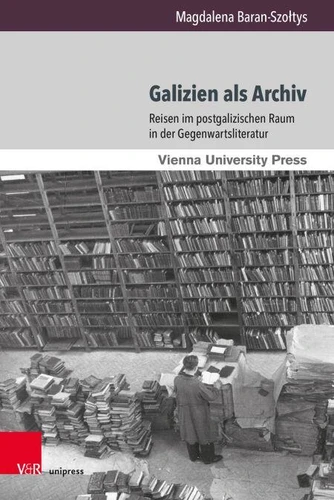
Galizien als Archiv. Reisen im postgalizischen Raum in der Gegenwartsliteratur
Par :Formats :
Disponible dans votre compte client Decitre ou Furet du Nord dès validation de votre commande. Le format PDF est :
- Compatible avec une lecture sur My Vivlio (smartphone, tablette, ordinateur)
- Compatible avec une lecture sur liseuses Vivlio
- Pour les liseuses autres que Vivlio, vous devez utiliser le logiciel Adobe Digital Edition. Non compatible avec la lecture sur les liseuses Kindle, Remarkable et Sony
 , qui est-ce ?
Notre partenaire de plateforme de lecture numérique où vous retrouverez l'ensemble de vos ebooks gratuitement
Pour en savoir plus sur nos ebooks, consultez notre aide en ligne ici
C'est si simple ! Lisez votre ebook avec l'app Vivlio sur votre tablette, mobile ou ordinateur :

- Nombre de pages327
- FormatPDF
- ISBN978-3-8470-1122-4
- EAN9783847011224
- Date de parution15/02/2021
- Protection num.pas de protection
- Taille8 Mo
- Infos supplémentairespdf
- ÉditeurV&R Unipress
Résumé
Wie reist man heute in historische Räume wie Galizien und vor allem wozu? Dies beantwortet der vorliegende Band, welcher zeitgenössische Repräsentationen von Galizien in polnischen und deutschsprachigen literarischen und publizistischen Reisetexten analysiert. Magdalena Baran-Szoltys beleuchtet Funktionsweisen von Reisen in historische und geographische Räume und entwickelt daran anschließend die These von Galizien als einem Archiv, in welchem gewisse Themen, Mythen und materielle Relikte aufbewahrt werden.
Dabei sichtet sie drei Archivarten: historisch-literarisches, familiäres und idiosynkratisches Archiv. Das entworfene Modell zur Untersuchung solcher Reisen liefert erhellende Erkenntnisse und ist für vergleichbar gelagerte europäische Räume wie Siebenbürgen oder die Bukowina anwendbar. How do people travel to historical spaces like Galicia today and, above all, what for? This book offers answers to those questions by analysing contemporary representations of Galicia in Polish and German-language literary texts and journalistic travel accounts.
Magdalena Baran-Szoltys sheds light on the role of travels to historical spaces and then develops the thesis of Galicia as an archive/archival space in which certain themes, myths, material relics etc. are stored. She determines three types of archives: historical-literary, idiosyncratic and family. The model designed for the study of such journeys provides revealing insights and can be applied to other spaces in Europe with similar characteristics, e.g.
Bukovina.
Dabei sichtet sie drei Archivarten: historisch-literarisches, familiäres und idiosynkratisches Archiv. Das entworfene Modell zur Untersuchung solcher Reisen liefert erhellende Erkenntnisse und ist für vergleichbar gelagerte europäische Räume wie Siebenbürgen oder die Bukowina anwendbar. How do people travel to historical spaces like Galicia today and, above all, what for? This book offers answers to those questions by analysing contemporary representations of Galicia in Polish and German-language literary texts and journalistic travel accounts.
Magdalena Baran-Szoltys sheds light on the role of travels to historical spaces and then develops the thesis of Galicia as an archive/archival space in which certain themes, myths, material relics etc. are stored. She determines three types of archives: historical-literary, idiosyncratic and family. The model designed for the study of such journeys provides revealing insights and can be applied to other spaces in Europe with similar characteristics, e.g.
Bukovina.