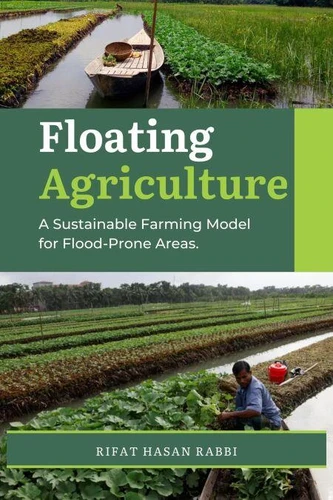
Floating Agriculture: A Sustainable Farming Model for Flood-Prone Areas presents a comprehensive, research-based exploration of an indigenous yet highly relevant agricultural system designed for regions affected by prolonged and recurrent flooding. As climate change intensifies flood frequency, duration, and unpredictability across deltaic and low-lying landscapes, conventional land-based agriculture increasingly fails to ensure stable food production and rural livelihoods.
This ebook critically examines floating agriculture as a climate-resilient adaptation strategy that transforms inundated water bodies into productive spaces for crop cultivation. The book traces the historical origins of floating agriculture, with particular emphasis on the traditional dhap or baira systems of Bangladesh, while also situating the practice within a global context that includes comparable systems from South and Southeast Asia and ancient civilizations.
It explains the agro-ecological conditions of flood-prone environments, detailing hydrological regimes, soil constraints, and socio-economic vulnerabilities that necessitate alternative farming approaches. The structural design, materials, nutrient dynamics, and crop management practices of floating beds are described in a systematic and scientific manner, supported by comparative analysis and tabulated data.
Beyond technical aspects, the ebook evaluates agronomic performance, environmental sustainability, and contributions to food security and livelihoods. It highlights how floating agriculture enhances year-round food availability, dietary diversity, income generation, and resilience among smallholder and landless farmers, with particular attention to gender dimensions and women's participation. The discussion also addresses challenges such as labor intensity, material availability, market access, and climate-related risks, offering balanced insights into both opportunities and limitations.
Intended for students, researchers, development practitioners, policymakers, and environmentally conscious readers, this ebook synthesizes scientific literature, empirical observations, and indigenous knowledge to position floating agriculture as a viable, scalable, and sustainable farming model. It contributes to ongoing discourse on climate-smart agriculture, adaptation strategies, and sustainable food systems in flood-prone regions, making it a valuable resource for academic study and practical application alike.
Floating Agriculture: A Sustainable Farming Model for Flood-Prone Areas presents a comprehensive, research-based exploration of an indigenous yet highly relevant agricultural system designed for regions affected by prolonged and recurrent flooding. As climate change intensifies flood frequency, duration, and unpredictability across deltaic and low-lying landscapes, conventional land-based agriculture increasingly fails to ensure stable food production and rural livelihoods.
This ebook critically examines floating agriculture as a climate-resilient adaptation strategy that transforms inundated water bodies into productive spaces for crop cultivation. The book traces the historical origins of floating agriculture, with particular emphasis on the traditional dhap or baira systems of Bangladesh, while also situating the practice within a global context that includes comparable systems from South and Southeast Asia and ancient civilizations.
It explains the agro-ecological conditions of flood-prone environments, detailing hydrological regimes, soil constraints, and socio-economic vulnerabilities that necessitate alternative farming approaches. The structural design, materials, nutrient dynamics, and crop management practices of floating beds are described in a systematic and scientific manner, supported by comparative analysis and tabulated data.
Beyond technical aspects, the ebook evaluates agronomic performance, environmental sustainability, and contributions to food security and livelihoods. It highlights how floating agriculture enhances year-round food availability, dietary diversity, income generation, and resilience among smallholder and landless farmers, with particular attention to gender dimensions and women's participation. The discussion also addresses challenges such as labor intensity, material availability, market access, and climate-related risks, offering balanced insights into both opportunities and limitations.
Intended for students, researchers, development practitioners, policymakers, and environmentally conscious readers, this ebook synthesizes scientific literature, empirical observations, and indigenous knowledge to position floating agriculture as a viable, scalable, and sustainable farming model. It contributes to ongoing discourse on climate-smart agriculture, adaptation strategies, and sustainable food systems in flood-prone regions, making it a valuable resource for academic study and practical application alike.

 , qui est-ce ?