This eBook offers a comprehensive, scientific, and context-specific analysis of the complex relationship between climate change and food security in the coastal regions of Bangladesh. Situated at the frontline of global climate vulnerability, coastal Bangladesh provides a critical case for understanding how environmental change interacts with agriculture, livelihoods, nutrition, and socio-economic systems.
Drawing on established academic frameworks, particularly the four pillars of food security-availability, access, utilization, and stability-this book examines how climate-induced stressors systematically undermine food systems and human well-being. The book explores key climate change drivers affecting coastal Bangladesh, including sea-level rise, salinity intrusion in soil and water, cyclones, storm surges, flooding, erratic rainfall, and rising temperatures.
It explains how these stressors disrupt crop production, fisheries, livestock systems, and post-harvest processes, leading to reduced productivity, increased production risks, and heightened livelihood insecurity. Particular emphasis is placed on rice-based farming systems, coastal fisheries, and smallholder agriculture, which form the backbone of food security for millions of coastal households. Beyond biophysical impacts, the eBook provides an in-depth discussion of socio-economic and gender dimensions of food insecurity.
It highlights how climate change disproportionately affects smallholder farmers, landless laborers, women, children, and marginalized communities due to limited adaptive capacity, resource constraints, and institutional barriers. The analysis demonstrates how income volatility, market disruptions, migration, health challenges, and caregiving burdens interact with environmental change to shape nutritional outcomes and long-term food stability.
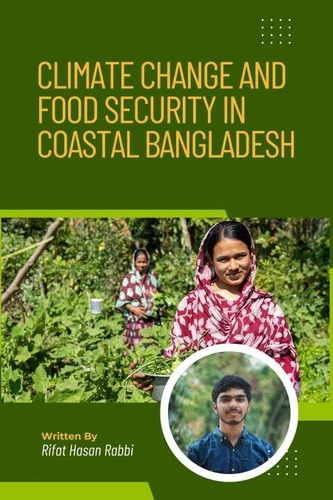
This eBook offers a comprehensive, scientific, and context-specific analysis of the complex relationship between climate change and food security in the coastal regions of Bangladesh. Situated at the frontline of global climate vulnerability, coastal Bangladesh provides a critical case for understanding how environmental change interacts with agriculture, livelihoods, nutrition, and socio-economic systems.
Drawing on established academic frameworks, particularly the four pillars of food security-availability, access, utilization, and stability-this book examines how climate-induced stressors systematically undermine food systems and human well-being. The book explores key climate change drivers affecting coastal Bangladesh, including sea-level rise, salinity intrusion in soil and water, cyclones, storm surges, flooding, erratic rainfall, and rising temperatures.
It explains how these stressors disrupt crop production, fisheries, livestock systems, and post-harvest processes, leading to reduced productivity, increased production risks, and heightened livelihood insecurity. Particular emphasis is placed on rice-based farming systems, coastal fisheries, and smallholder agriculture, which form the backbone of food security for millions of coastal households. Beyond biophysical impacts, the eBook provides an in-depth discussion of socio-economic and gender dimensions of food insecurity.
It highlights how climate change disproportionately affects smallholder farmers, landless laborers, women, children, and marginalized communities due to limited adaptive capacity, resource constraints, and institutional barriers. The analysis demonstrates how income volatility, market disruptions, migration, health challenges, and caregiving burdens interact with environmental change to shape nutritional outcomes and long-term food stability.

 , qui est-ce ?