Nouveauté
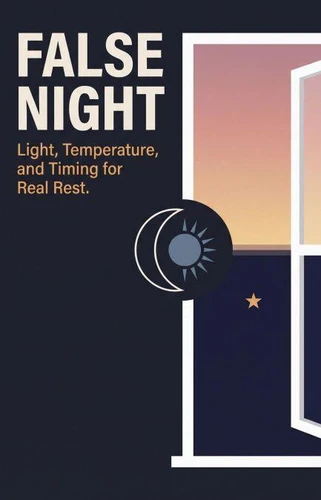
False Night: Light, Temperature, and Timing for Real Rest
Par :Formats :
Disponible dans votre compte client Decitre ou Furet du Nord dès validation de votre commande. Le format ePub est :
- Compatible avec une lecture sur My Vivlio (smartphone, tablette, ordinateur)
- Compatible avec une lecture sur liseuses Vivlio
- Pour les liseuses autres que Vivlio, vous devez utiliser le logiciel Adobe Digital Edition. Non compatible avec la lecture sur les liseuses Kindle, Remarkable et Sony
 , qui est-ce ?
Notre partenaire de plateforme de lecture numérique où vous retrouverez l'ensemble de vos ebooks gratuitement
Pour en savoir plus sur nos ebooks, consultez notre aide en ligne ici
C'est si simple ! Lisez votre ebook avec l'app Vivlio sur votre tablette, mobile ou ordinateur :

- FormatePub
- ISBN8235777286
- EAN9798235777286
- Date de parution01/07/2026
- Protection num.pas de protection
- Infos supplémentairesepub
- ÉditeurIoakim Ioakim
Résumé
Most sleep advice treats your bedroom like an afterthought - something to tidy up once you've already fixed your mindset, your caffeine intake, your stress. But your body isn't listening to your intentions. It's reading your environment. Light tells your internal clock what time it is. Temperature tells your body when to shut down for the night. And when those signals are wrong - a phone screen at 11pm, an overheated bedroom, a Monday morning that arrives like jet lag every single week - no amount of willpower fixes the sleep that follows.
False Night explains exactly how your circadian system reads its surroundings, and why the gap between what modern life provides and what your biology expects has gotten so wide. You'll learn why morning light matters more than evening darkness, why a warm bath before bed works better than a cold room alone, why "blue light" advice is usually half-right, and how to build a bedroom that actually functions as a signal system rather than just a place to lie down.
This isn't a book about sleep disorders, supplements, or expensive gadgets. It's a clear, evidence-grounded explanation of the three environmental levers - light, temperature, and timing - that your body is already built to respond to, paired with specific, realistic ways to use them, whether you control your whole household's schedule or none of it. If you've done the obvious things and you're still not sleeping the way you'd like, the problem might not be in your head.
It might be in the room.
False Night explains exactly how your circadian system reads its surroundings, and why the gap between what modern life provides and what your biology expects has gotten so wide. You'll learn why morning light matters more than evening darkness, why a warm bath before bed works better than a cold room alone, why "blue light" advice is usually half-right, and how to build a bedroom that actually functions as a signal system rather than just a place to lie down.
This isn't a book about sleep disorders, supplements, or expensive gadgets. It's a clear, evidence-grounded explanation of the three environmental levers - light, temperature, and timing - that your body is already built to respond to, paired with specific, realistic ways to use them, whether you control your whole household's schedule or none of it. If you've done the obvious things and you're still not sleeping the way you'd like, the problem might not be in your head.
It might be in the room.
A propos de Patricia Rafi

2,99 €
3,49 €