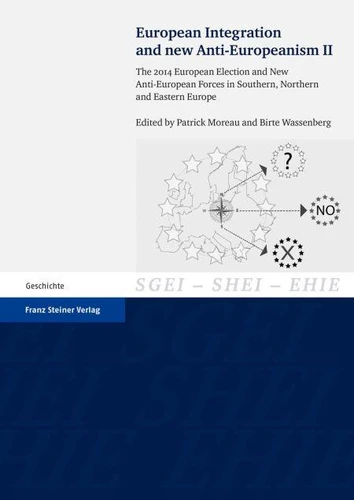
European Integration and new Anti-Europeanism. Vol. 2. The 2014 European Election and New Anti-European Forces in Southern, Northern and Eastern Europe
Par : ,Formats :
Disponible dans votre compte client Decitre ou Furet du Nord dès validation de votre commande. Le format PDF est :
- Compatible avec une lecture sur My Vivlio (smartphone, tablette, ordinateur)
- Compatible avec une lecture sur liseuses Vivlio
- Pour les liseuses autres que Vivlio, vous devez utiliser le logiciel Adobe Digital Edition. Non compatible avec la lecture sur les liseuses Kindle, Remarkable et Sony
 , qui est-ce ?
Notre partenaire de plateforme de lecture numérique où vous retrouverez l'ensemble de vos ebooks gratuitement
Pour en savoir plus sur nos ebooks, consultez notre aide en ligne ici
C'est si simple ! Lisez votre ebook avec l'app Vivlio sur votre tablette, mobile ou ordinateur :

- Nombre de pages239
- FormatPDF
- ISBN978-3-515-11456-1
- EAN9783515114561
- Date de parution23/08/2016
- Protection num.Digital Watermarking
- Taille2 Mo
- Infos supplémentairespdf
- ÉditeurFranz Steiner
Résumé
The economic crises since 2008, the tensions concerning the Euro, the Greek question and the refugee problem have fuelled a strong "Eurosceptic" movement. At the 2014 European elections, the rise of Eurosceptic forces could be observed in virtually all Member States of the EU. This publication regroups the contributions to a Conference organized 2014 in Strasburg by the CNRS-University of Strasbourg research unit "UMR Dynamiques européennes", in the framework of the IDEX excellence project "The European Integration and the New Anti-Europeanism".
In this second of two volumes, three groups of EU Member States are analysed: Mediterranean (Cyprus, Spain, Portugal, Greece), Scandinavian States (Sweden, Finland) and Austria; finally, Eastern European and Baltic States (Czech Republic, Slovakia, Hungary, Estonia, Latvia).
Does the discourse of Eurosceptic parties in Eastern Europe differ from national-populists in the Nordic States or Austria? Is anti-Europeanism of the Greek or Cypriot extreme right similar to that of "parties of disruption" in Italy (Five Star Movement) or Spain (Podemos)? Can we equate anti-Europeanism of Czech Communists and alter-Europeanists in the Baltic States?
Does the discourse of Eurosceptic parties in Eastern Europe differ from national-populists in the Nordic States or Austria? Is anti-Europeanism of the Greek or Cypriot extreme right similar to that of "parties of disruption" in Italy (Five Star Movement) or Spain (Podemos)? Can we equate anti-Europeanism of Czech Communists and alter-Europeanists in the Baltic States?