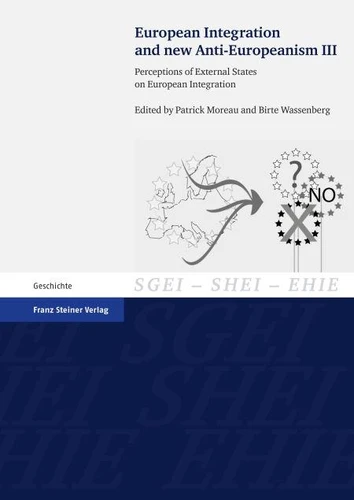
European Integration and new Anti-Europeanism. Vol. 3. Perceptions of External States on European Integration
Par : ,Formats :
Disponible dans votre compte client Decitre ou Furet du Nord dès validation de votre commande. Le format PDF est :
- Compatible avec une lecture sur My Vivlio (smartphone, tablette, ordinateur)
- Compatible avec une lecture sur liseuses Vivlio
- Pour les liseuses autres que Vivlio, vous devez utiliser le logiciel Adobe Digital Edition. Non compatible avec la lecture sur les liseuses Kindle, Remarkable et Sony
 , qui est-ce ?
Notre partenaire de plateforme de lecture numérique où vous retrouverez l'ensemble de vos ebooks gratuitement
Pour en savoir plus sur nos ebooks, consultez notre aide en ligne ici
C'est si simple ! Lisez votre ebook avec l'app Vivlio sur votre tablette, mobile ou ordinateur :

- Nombre de pages184
- FormatPDF
- ISBN978-3-515-11270-3
- EAN9783515112703
- Date de parution05/10/2018
- Protection num.Digital Watermarking
- Taille1 Mo
- Infos supplémentairespdf
- ÉditeurFranz Steiner
Résumé
The history of European integration has always known "external states" that did not want or were not able to join the process of European integration. The EU might indeed not be seen as attractive: Since 2008, it has had to face many crises, first the financial crisis, then the migration and Schengen crises in 2015, and finally the "leave" vote in Great Britain in 2016, the so-called "Brexit". Euro-skepticism has continually increased in EU-member states as the rejection of various EU treaties proved.
On national as well as EU levels, the strength of anti-European parties has grown. The present volume, edited by Birte Wassenberg and Patrick Moreau, concentrates on these "external states", particularly their attitude towards Europe. By looking at the geopolitical context, a wide range from historical constants to a changing of attitudes is shown and proves that the EU remains a fundamental actor of European politics and that its attraction continues to be very powerful.
On national as well as EU levels, the strength of anti-European parties has grown. The present volume, edited by Birte Wassenberg and Patrick Moreau, concentrates on these "external states", particularly their attitude towards Europe. By looking at the geopolitical context, a wide range from historical constants to a changing of attitudes is shown and proves that the EU remains a fundamental actor of European politics and that its attraction continues to be very powerful.