
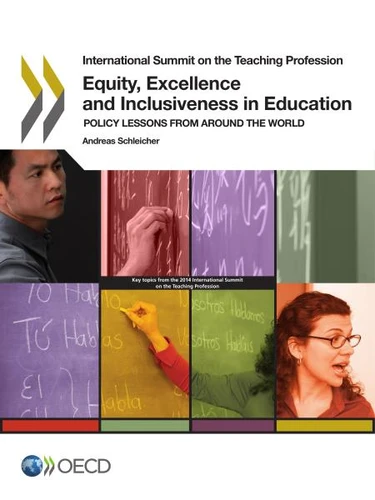
Equity, excellence and inclusiveness in education. Policy lessons from around the world
Par :Formats :
Disponible dans votre compte client Decitre ou Furet du Nord dès validation de votre commande. Le format PDF est :
- Compatible avec une lecture sur My Vivlio (smartphone, tablette, ordinateur)
- Compatible avec une lecture sur liseuses Vivlio
- Pour les liseuses autres que Vivlio, vous devez utiliser le logiciel Adobe Digital Edition. Non compatible avec la lecture sur les liseuses Kindle, Remarkable et Sony
 , qui est-ce ?
Notre partenaire de plateforme de lecture numérique où vous retrouverez l'ensemble de vos ebooks gratuitement
Pour en savoir plus sur nos ebooks, consultez notre aide en ligne ici
C'est si simple ! Lisez votre ebook avec l'app Vivlio sur votre tablette, mobile ou ordinateur :

- Nombre de pages112
- FormatPDF
- ISBN978-92-64-21403-3
- EAN9789264214033
- Date de parution04/07/2014
- Protection num.Digital Watermarking
- Taille2 Mo
- Infos supplémentairespdf
- ÉditeurOECD
Résumé
Excellence in education without equity risks leading to large economic and social disparities; equity in education at the expense of quality is a meaningless aspiration. The most advanced education systems now set ambitious goals for all students, focusing on both excellence and equity. They also equip their teachers with the pedagogic skills that have been proven effective and with enough autonomy so that teachers can use their own creativity in determining the content and instruction they provide to their individual students.
The fourth International Summit on the Teaching Profession brought together education ministers, union leaders and other teacher leaders from high-performing and rapidly improving education systems, as measured by PISA (the OECD Programme for International Student Assessment ). Their aim was to discuss equity, excellence and inclusiveness in education by exploring three questions:. How are high-quality teachers developed, and how do schools with the greatest need attract and retain them?.
How can equity be ensured in increasingly devolved education systems? and. What kinds of learning environments address the needs of all students?To underpin the discussions, this publication identifies some of the steps policy makers can take to build school systems that are both equitable and excellent. The analysis is complemented with examples that illustrate proven or promising practices in specific countries.
The fourth International Summit on the Teaching Profession brought together education ministers, union leaders and other teacher leaders from high-performing and rapidly improving education systems, as measured by PISA (the OECD Programme for International Student Assessment ). Their aim was to discuss equity, excellence and inclusiveness in education by exploring three questions:. How are high-quality teachers developed, and how do schools with the greatest need attract and retain them?.
How can equity be ensured in increasingly devolved education systems? and. What kinds of learning environments address the needs of all students?To underpin the discussions, this publication identifies some of the steps policy makers can take to build school systems that are both equitable and excellent. The analysis is complemented with examples that illustrate proven or promising practices in specific countries.
A propos de OCDE


32,99 €

72,99 €

33,99 €

32,99 €
32,99 €

32,00 €

Tax compilance by design
E-book
16,00 €

16,00 €

19,00 €

16,00 €

25,00 €


23,00 €

Women in business 2014
E-book
31,00 €


27,00 €