SOLDES
Jusqu'à -70% sur une sélection d'articles*

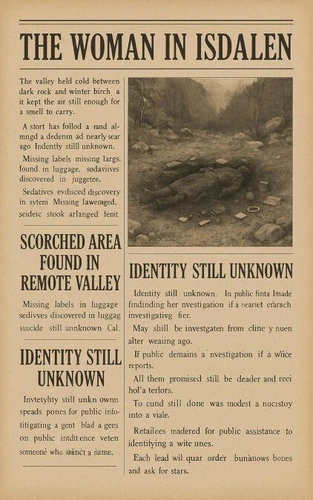
Episode 3: The Woman in Isdalen. Last Seen Casefile Anomalies, #3
Par :Formats :
Disponible dans votre compte client Decitre ou Furet du Nord dès validation de votre commande. Le format ePub est :
- Compatible avec une lecture sur My Vivlio (smartphone, tablette, ordinateur)
- Compatible avec une lecture sur liseuses Vivlio
- Pour les liseuses autres que Vivlio, vous devez utiliser le logiciel Adobe Digital Edition. Non compatible avec la lecture sur les liseuses Kindle, Remarkable et Sony
 , qui est-ce ?
Notre partenaire de plateforme de lecture numérique où vous retrouverez l'ensemble de vos ebooks gratuitement
Pour en savoir plus sur nos ebooks, consultez notre aide en ligne ici
C'est si simple ! Lisez votre ebook avec l'app Vivlio sur votre tablette, mobile ou ordinateur :

- FormatePub
- ISBN8233811364
- EAN9798233811364
- Date de parution20/04/2026
- Protection num.pas de protection
- Infos supplémentairesepub
- ÉditeurLinda Balsamo
Résumé
Isdalen, Norway. 1970. Two hikers follow a strange smell into a remote valley and discover a burned body surrounded by carefully placed objects. There is no identification. No clear explanation. Only details that resist a simple reading. The woman had traveled across Europe under multiple names. Hotel records show short stays, cash payments, and subtle variations in identity. Her luggage contains wigs, altered clothing, and a coded notebook mapping a precise route across cities.
Even in death, she remains controlled. Forensic analysis reveals a layered sequence-sedatives, carbon monoxide, and fire-raising questions about timing, intent, and circumstance. The scene suggests order, but not clarity. Every element appears deliberate, yet none provide a complete answer. The Woman in Isdalen reconstructs the case through evidence, movement, and method. It separates confirmed findings from later speculation, focusing on the measurable structure of the investigation rather than the myths that followed.
This is not a story about intrigue. It is a study of identity built to disappear-and the limits of what evidence can recover once it does.
Even in death, she remains controlled. Forensic analysis reveals a layered sequence-sedatives, carbon monoxide, and fire-raising questions about timing, intent, and circumstance. The scene suggests order, but not clarity. Every element appears deliberate, yet none provide a complete answer. The Woman in Isdalen reconstructs the case through evidence, movement, and method. It separates confirmed findings from later speculation, focusing on the measurable structure of the investigation rather than the myths that followed.
This is not a story about intrigue. It is a study of identity built to disappear-and the limits of what evidence can recover once it does.
A propos de K.G. Groves


3,99 €

The Tent in the Rain
E-book
4,49 €
Where Is Your Chain?
E-book
3,49 €

5,49 €

I AM The Gate
E-book
5,49 €