Minneapolis, Minnesota. 1997. Speech-language pathologist Clara Voss disappears after locking up her clinic on Lake Street following her final therapy session of the day. The security footage glitches to static the moment she waves goodbye. Her car is found nearby with the keys still inside and a blue therapy folder resting open on the dashboard. The pages are blank. Police find no struggle, no footprints, and no explanation for how a woman could vanish in broad daylight without leaving behind a single unfinished sentence.
Then her voice starts returning through other people. Patients at the clinic begin speaking in Clara's exact cadence. Children repeat phrases she once taught them despite never meeting her. Therapists hear her hum inside audio recordings after hours. Phone calls arrive from blocked numbers carrying only breathing and one repeated phrase:Session starts now. As Clara's girlfriend Lena searches for answers, the clinic itself begins changing.
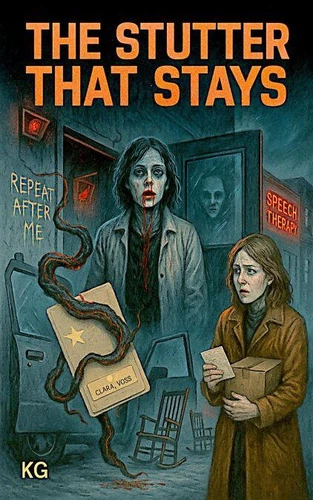
Empty chairs rock on their own. Blue folders fall from ceilings already filled with fresh handwriting. Mirrors move lips a half-second too late. And anyone who says the word "home" long enough begins sounding exactly like Clara. The Stutter That Stays is a slow-burning dread novella about identity, memory, language, and the terrifying possibility that a voice can outlive the person who once owned it.
Filled with flickering neon, therapy tapes, winter silence, and haunted speech patterns, it blends psychological horror with existential linguistic dread. Some voices disappear. Others learn how to stay.
Minneapolis, Minnesota. 1997. Speech-language pathologist Clara Voss disappears after locking up her clinic on Lake Street following her final therapy session of the day. The security footage glitches to static the moment she waves goodbye. Her car is found nearby with the keys still inside and a blue therapy folder resting open on the dashboard. The pages are blank. Police find no struggle, no footprints, and no explanation for how a woman could vanish in broad daylight without leaving behind a single unfinished sentence.
Then her voice starts returning through other people. Patients at the clinic begin speaking in Clara's exact cadence. Children repeat phrases she once taught them despite never meeting her. Therapists hear her hum inside audio recordings after hours. Phone calls arrive from blocked numbers carrying only breathing and one repeated phrase:Session starts now. As Clara's girlfriend Lena searches for answers, the clinic itself begins changing.
Empty chairs rock on their own. Blue folders fall from ceilings already filled with fresh handwriting. Mirrors move lips a half-second too late. And anyone who says the word "home" long enough begins sounding exactly like Clara. The Stutter That Stays is a slow-burning dread novella about identity, memory, language, and the terrifying possibility that a voice can outlive the person who once owned it.
Filled with flickering neon, therapy tapes, winter silence, and haunted speech patterns, it blends psychological horror with existential linguistic dread. Some voices disappear. Others learn how to stay.

 , qui est-ce ?