SOLDES
Jusqu'à -70% sur une sélection d'articles*

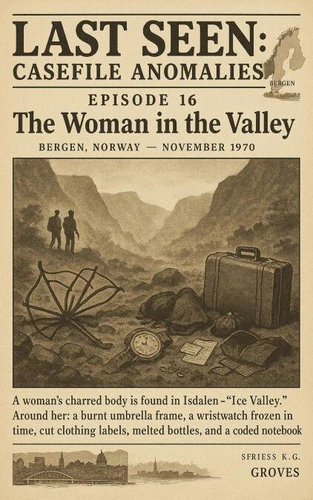
Episode 16: The Woman in the Valley. Last Seen Casefile Anomalies
Par :Formats :
Disponible dans votre compte client Decitre ou Furet du Nord dès validation de votre commande. Le format ePub est :
- Compatible avec une lecture sur My Vivlio (smartphone, tablette, ordinateur)
- Compatible avec une lecture sur liseuses Vivlio
- Pour les liseuses autres que Vivlio, vous devez utiliser le logiciel Adobe Digital Edition. Non compatible avec la lecture sur les liseuses Kindle, Remarkable et Sony
 , qui est-ce ?
Notre partenaire de plateforme de lecture numérique où vous retrouverez l'ensemble de vos ebooks gratuitement
Pour en savoir plus sur nos ebooks, consultez notre aide en ligne ici
C'est si simple ! Lisez votre ebook avec l'app Vivlio sur votre tablette, mobile ou ordinateur :

- FormatePub
- ISBN8235622135
- EAN9798235622135
- Date de parution04/05/2026
- Protection num.pas de protection
- Infos supplémentairesepub
- ÉditeurIoakim Ioakim
Résumé
Isdalen, Norway. 1970. A woman is found burned in a remote valley, surrounded by carefully placed objects and stripped of all identifying marks. Labels have been cut from her clothing. Her belongings show signs of deliberate alteration. No name is found. The investigation begins with fragments. A suitcase recovered from a railway station contains wigs, altered garments, and a coded notebook. At first glance, the writing appears cryptic.
Under analysis, it becomes a travel record-mapping a route through multiple European cities under different identities. Each hotel stay is brief. Each name is different. Each movement is controlled. Forensic analysis adds further layers. Dental work suggests extensive treatment abroad. Hair and enamel isotope testing points toward a childhood in central Europe. Chemical evidence indicates sedatives in the body prior to the fire, while soot in the airway confirms she was alive during the burning.
The scene suggests intention. The evidence allows multiple interpretations. The Woman in the Valley reconstructs the case through physical evidence, travel patterns, forensic chemistry, and long-term investigative developments. It separates documented findings from speculation, focusing on what can be measured across time rather than what can be assumed. The result is not a solved identity. It is a case where identity was carefully built-and then removed.
Under analysis, it becomes a travel record-mapping a route through multiple European cities under different identities. Each hotel stay is brief. Each name is different. Each movement is controlled. Forensic analysis adds further layers. Dental work suggests extensive treatment abroad. Hair and enamel isotope testing points toward a childhood in central Europe. Chemical evidence indicates sedatives in the body prior to the fire, while soot in the airway confirms she was alive during the burning.
The scene suggests intention. The evidence allows multiple interpretations. The Woman in the Valley reconstructs the case through physical evidence, travel patterns, forensic chemistry, and long-term investigative developments. It separates documented findings from speculation, focusing on what can be measured across time rather than what can be assumed. The result is not a solved identity. It is a case where identity was carefully built-and then removed.
A propos de K.G. Groves



3,99 €

The Tent in the Rain
E-book
4,49 €


Where Is Your Chain?
E-book
3,49 €

5,49 €



I AM The Gate
E-book
5,49 €