Northern California, 1978. Five friends leave a college basketball game and begin the drive home. They never arrive. Days later, their car is found far from their intended route, deep in the Plumas National Forest on a snowbound road. It is unlocked, undamaged, and contains food wrappers and fuel-nothing to suggest a breakdown that would force them into the night. The road only leads deeper into the mountains.
Search teams follow the terrain rather than the assumption, and months later, as snow begins to melt, the case reveals itself in stages. A remote Forest Service trailer becomes the center of the second phase. Inside, one of the men is found alive for weeks after the initial disappearance-surrounded by food, fuel, and supplies that were only partially used. Outside, the others are located along the route between the car and the shelter, each marking a point where direction and endurance failed.
One man is never found. The Boys in the Snow reconstructs the case through terrain analysis, weather conditions, vehicle position, survival timelines, and behavioral patterns under stress. It separates evidence from speculation, focusing on what can be supported by the physical record. The result is not a case defined by a single mistake. It is a case built from a sequence of reasonable decisions made under conditions that did not allow for error.
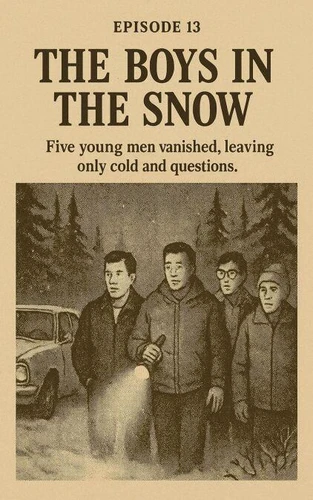
Northern California, 1978. Five friends leave a college basketball game and begin the drive home. They never arrive. Days later, their car is found far from their intended route, deep in the Plumas National Forest on a snowbound road. It is unlocked, undamaged, and contains food wrappers and fuel-nothing to suggest a breakdown that would force them into the night. The road only leads deeper into the mountains.
Search teams follow the terrain rather than the assumption, and months later, as snow begins to melt, the case reveals itself in stages. A remote Forest Service trailer becomes the center of the second phase. Inside, one of the men is found alive for weeks after the initial disappearance-surrounded by food, fuel, and supplies that were only partially used. Outside, the others are located along the route between the car and the shelter, each marking a point where direction and endurance failed.
One man is never found. The Boys in the Snow reconstructs the case through terrain analysis, weather conditions, vehicle position, survival timelines, and behavioral patterns under stress. It separates evidence from speculation, focusing on what can be supported by the physical record. The result is not a case defined by a single mistake. It is a case built from a sequence of reasonable decisions made under conditions that did not allow for error.


 , qui est-ce ?