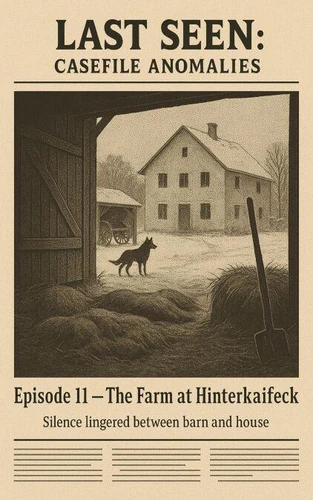
Bavaria, Germany. March 1922. A remote farmstead falls silent. Days pass before neighbors investigate. Inside the barn, four bodies are discovered beneath hay. In the house, two more. The entire household-family and newly arrived maid-has been killed. The scene should suggest urgency. It doesn't. Food has been prepared after the estimated time of death. The cattle have been fed. The stove shows recent use.
Someone remained on the property after the killings, moving through the routines of the household as if nothing had changed. The physical evidence offers fragments without resolution:Footprints lead from the forest toward the farm-but none clearly return. Keys are missing. An unfamiliar newspaper lies inside the home. A farm tool later discovered in the attic matches the injuries. Witness accounts describe prior unease-noises in the loft, signs of someone already present-but none provide proof that holds.
The Farm at Hinterkaifeck reconstructs the case through scene layout, physical evidence, timeline analysis, and documented testimony. It separates recorded fact from speculation, focusing on behavior, environment, and sequence rather than myth. The result is not a story of shock. It is a case defined by proximity. A place where the killer likely knew the routines, understood the space, and stayed long enough to finish what the household itself would have done.
Bavaria, Germany. March 1922. A remote farmstead falls silent. Days pass before neighbors investigate. Inside the barn, four bodies are discovered beneath hay. In the house, two more. The entire household-family and newly arrived maid-has been killed. The scene should suggest urgency. It doesn't. Food has been prepared after the estimated time of death. The cattle have been fed. The stove shows recent use.
Someone remained on the property after the killings, moving through the routines of the household as if nothing had changed. The physical evidence offers fragments without resolution:Footprints lead from the forest toward the farm-but none clearly return. Keys are missing. An unfamiliar newspaper lies inside the home. A farm tool later discovered in the attic matches the injuries. Witness accounts describe prior unease-noises in the loft, signs of someone already present-but none provide proof that holds.
The Farm at Hinterkaifeck reconstructs the case through scene layout, physical evidence, timeline analysis, and documented testimony. It separates recorded fact from speculation, focusing on behavior, environment, and sequence rather than myth. The result is not a story of shock. It is a case defined by proximity. A place where the killer likely knew the routines, understood the space, and stayed long enough to finish what the household itself would have done.


 , qui est-ce ?