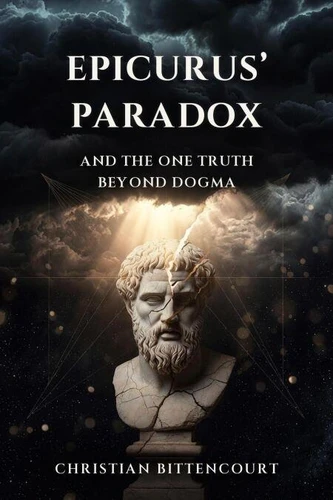
In this straightforward and uncomplicated essay, Christian Bittencourt confronts Epicurus' Paradox-the classic logical objection against an omnipotent, omniscient, and omnibenevolent God in the face of observable evil in the world. Instead of defending worn-out theodicies, he dissects the anthropomorphic premises that underpin the dilemma and proposes a systemic solution: God is not a person with moral intentions, but the neutral Totality of existence, governed by invariant laws.
Religions emerge as diverse cultural paths that converge on the same Single Truth, while human institutions often add layers of control that obscure the original messages of the masters. The result is a clear, unmediated vision where ethical responsibility springs from understanding the whole, not from fear of a celestial judge. A book for those seeking intellectual precision and spiritual depth without comfortable dogmas.
In this straightforward and uncomplicated essay, Christian Bittencourt confronts Epicurus' Paradox-the classic logical objection against an omnipotent, omniscient, and omnibenevolent God in the face of observable evil in the world. Instead of defending worn-out theodicies, he dissects the anthropomorphic premises that underpin the dilemma and proposes a systemic solution: God is not a person with moral intentions, but the neutral Totality of existence, governed by invariant laws.
Religions emerge as diverse cultural paths that converge on the same Single Truth, while human institutions often add layers of control that obscure the original messages of the masters. The result is a clear, unmediated vision where ethical responsibility springs from understanding the whole, not from fear of a celestial judge. A book for those seeking intellectual precision and spiritual depth without comfortable dogmas.


 , qui est-ce ?