SOLDES
Jusqu'à -70% sur une sélection d'articles*

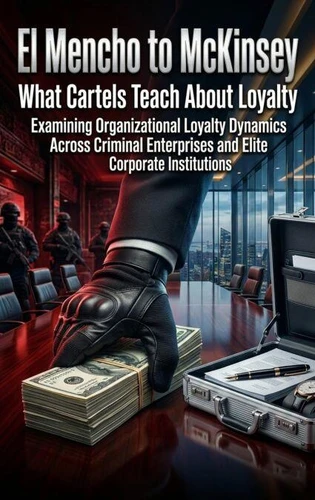
El Mencho to McKinsey: What Cartels Teach About Loyalty. Examining Organizational Loyalty Dynamics Across Criminal Enterprises and Elite Corporate Institutions
Par :Formats :
Disponible dans votre compte client Decitre ou Furet du Nord dès validation de votre commande. Le format ePub est :
- Compatible avec une lecture sur My Vivlio (smartphone, tablette, ordinateur)
- Compatible avec une lecture sur liseuses Vivlio
- Pour les liseuses autres que Vivlio, vous devez utiliser le logiciel Adobe Digital Edition. Non compatible avec la lecture sur les liseuses Kindle, Remarkable et Sony
 , qui est-ce ?
Notre partenaire de plateforme de lecture numérique où vous retrouverez l'ensemble de vos ebooks gratuitement
Pour en savoir plus sur nos ebooks, consultez notre aide en ligne ici
C'est si simple ! Lisez votre ebook avec l'app Vivlio sur votre tablette, mobile ou ordinateur :

- Nombre de pages177
- FormatePub
- ISBN978-3-565-31490-4
- EAN9783565314904
- Date de parution11/03/2026
- Protection num.pas de protection
- Taille1 Mo
- Infos supplémentairesepub
- ÉditeurEmphaloz Publishing House
Résumé
Loyalty is among the most strategically consequential forces within any organization - and among the least rigorously examined. Corporate management literature consistently treats loyalty as a cultural aspiration, yet some of the most structurally sophisticated loyalty systems observable in modern organizational study emerge not from elite consultancies but from criminal enterprises operating under conditions of extreme consequence.
The parallels are analytically uncomfortable and precisely for that reason worth examining with intellectual seriousness. This book explores the underlying dynamics of organizational loyalty as they manifest across two seemingly incompatible institutional contexts - cartel structures and elite corporate organizations. It examines how loyalty is constructed, enforced, and sustained differently when the consequences of defection are existential versus merely professional - and what these contrasting environments reveal about the fundamental mechanics of human allegiance within hierarchical systems.
It reveals the tension between loyalty built on genuine alignment and loyalty maintained through dependency, and why distinguishing between the two carries profound implications for organizational resilience. Rather than presenting a management formula, this book reframes assumptions about what organizational loyalty actually requires at its structural foundation. It navigates the mechanics of incentive design, consequence architecture, and the deliberate cultivation of institutional belonging - examining how leaders and organizations that understand loyalty as a constructed system rather than a cultural accident consistently demonstrate greater retention, cohesion, and operational durability across both legitimate and extreme organizational contexts.
The parallels are analytically uncomfortable and precisely for that reason worth examining with intellectual seriousness. This book explores the underlying dynamics of organizational loyalty as they manifest across two seemingly incompatible institutional contexts - cartel structures and elite corporate organizations. It examines how loyalty is constructed, enforced, and sustained differently when the consequences of defection are existential versus merely professional - and what these contrasting environments reveal about the fundamental mechanics of human allegiance within hierarchical systems.
It reveals the tension between loyalty built on genuine alignment and loyalty maintained through dependency, and why distinguishing between the two carries profound implications for organizational resilience. Rather than presenting a management formula, this book reframes assumptions about what organizational loyalty actually requires at its structural foundation. It navigates the mechanics of incentive design, consequence architecture, and the deliberate cultivation of institutional belonging - examining how leaders and organizations that understand loyalty as a constructed system rather than a cultural accident consistently demonstrate greater retention, cohesion, and operational durability across both legitimate and extreme organizational contexts.