Sofia Lane is a nonfiction author known for writing thoughtful books on emotional resilience, self-growth, modern relationships, and finding meaning in everyday life. Her calm and reflective writing style combines psychology, philosophy, and practical insight to help readers navigate life with greater clarity, balance, and self-awareness.
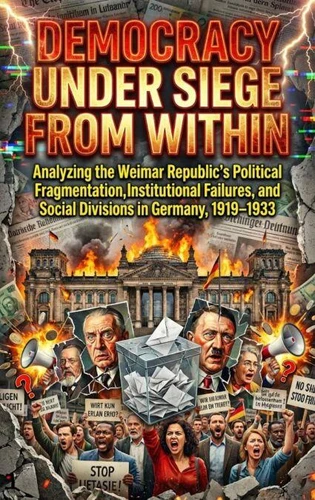
Democracy Under Siege from Within. Analyzing the Weimar Republic's Political Fragmentation, Institutional Failures, and Social Divisions in Germany, 1919–1933
Par :Formats :
Disponible dans votre compte client Decitre ou Furet du Nord dès validation de votre commande. Le format ePub est :
- Compatible avec une lecture sur My Vivlio (smartphone, tablette, ordinateur)
- Compatible avec une lecture sur liseuses Vivlio
- Pour les liseuses autres que Vivlio, vous devez utiliser le logiciel Adobe Digital Edition. Non compatible avec la lecture sur les liseuses Kindle, Remarkable et Sony
 , qui est-ce ?
Notre partenaire de plateforme de lecture numérique où vous retrouverez l'ensemble de vos ebooks gratuitement
Pour en savoir plus sur nos ebooks, consultez notre aide en ligne ici
C'est si simple ! Lisez votre ebook avec l'app Vivlio sur votre tablette, mobile ou ordinateur :

- Nombre de pages201
- FormatePub
- ISBN978-3-565-19887-0
- EAN9783565198870
- Date de parution27/01/2026
- Protection num.pas de protection
- Taille2 Mo
- Infos supplémentairesepub
- ÉditeurEmphaloz Publishing House
Résumé
The Weimar Republic did not fall to external invasion but collapsed under the weight of internal contradictions: a democratic constitution without widespread democratic conviction, economic instability that radicalized the middle class, political parties unable to build governing coalitions, and institutions that failed to protect themselves from those who sought their destruction.
This book examines the Republic's political dynamics through the decisions of key actors and the structural weaknesses they exploited.
It traces how the Versailles Treaty's punitive terms poisoned early legitimacy, how hyperinflation in 1923 destroyed savings and trust in state institutions, how paramilitary violence became normalized in street clashes between Communist and Nazi militants, and how centrist parties fragmented while extremes gained electoral strength. It analyzes the emergency presidential powers that circumvented parliament, the judiciary's lenient treatment of right-wing political violence, and the conservative elites who believed they could control radical movements for their own purposes. Drawing on parliamentary debates, newspaper coverage, political memoirs, police reports, and personal testimonies from citizens across the political spectrum, it reveals the everyday erosion of democratic norms: how propaganda techniques shaped public opinion, how economic anxiety translated into scapegoating, how coalition governments proved too weak to address crises, and how procedural democracy continued even as substantive democracy withered.
It explores how workers, intellectuals, women newly enfranchised, and veterans navigated political chaos while institutions meant to safeguard liberty instead enabled authoritarianism. This is a systematic examination of how democracies fail when citizens lose faith in shared institutions and elites prioritize power over principle.
It traces how the Versailles Treaty's punitive terms poisoned early legitimacy, how hyperinflation in 1923 destroyed savings and trust in state institutions, how paramilitary violence became normalized in street clashes between Communist and Nazi militants, and how centrist parties fragmented while extremes gained electoral strength. It analyzes the emergency presidential powers that circumvented parliament, the judiciary's lenient treatment of right-wing political violence, and the conservative elites who believed they could control radical movements for their own purposes. Drawing on parliamentary debates, newspaper coverage, political memoirs, police reports, and personal testimonies from citizens across the political spectrum, it reveals the everyday erosion of democratic norms: how propaganda techniques shaped public opinion, how economic anxiety translated into scapegoating, how coalition governments proved too weak to address crises, and how procedural democracy continued even as substantive democracy withered.
It explores how workers, intellectuals, women newly enfranchised, and veterans navigated political chaos while institutions meant to safeguard liberty instead enabled authoritarianism. This is a systematic examination of how democracies fail when citizens lose faith in shared institutions and elites prioritize power over principle.
A propos de Sofia Lane

4,49 €