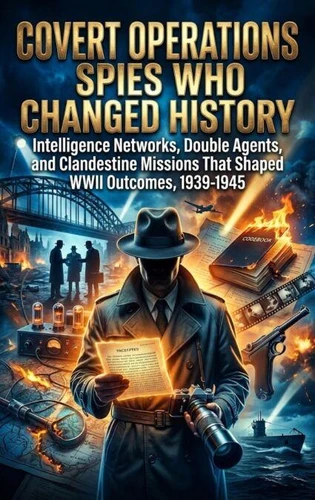
Covert Operations: Spies Who Changed History. Intelligence Networks, Double Agents, and Clandestine Missions That Shaped WWII Outcomes, 1939-1945
Par :Formats :
Disponible dans votre compte client Decitre ou Furet du Nord dès validation de votre commande. Le format ePub est :
- Compatible avec une lecture sur My Vivlio (smartphone, tablette, ordinateur)
- Compatible avec une lecture sur liseuses Vivlio
- Pour les liseuses autres que Vivlio, vous devez utiliser le logiciel Adobe Digital Edition. Non compatible avec la lecture sur les liseuses Kindle, Remarkable et Sony
 , qui est-ce ?
Notre partenaire de plateforme de lecture numérique où vous retrouverez l'ensemble de vos ebooks gratuitement
Pour en savoir plus sur nos ebooks, consultez notre aide en ligne ici
C'est si simple ! Lisez votre ebook avec l'app Vivlio sur votre tablette, mobile ou ordinateur :

- Nombre de pages221
- FormatePub
- ISBN978-3-565-24607-6
- EAN9783565246076
- Date de parution14/02/2026
- Protection num.pas de protection
- Taille2 Mo
- Infos supplémentairesepub
- ÉditeurEmphaloz Publishing House
Résumé
Behind every major military decision of World War II lay invisible networks of spies, code-breakers, and intelligence operatives whose work determined the course of battles, invasions, and negotiations. From the Double Cross System that deceived Hitler about D-Day to the Lucy spy ring feeding Soviet commanders German battle plans, covert operations influenced strategic outcomes as profoundly as any tank division or bomber fleet.
This book examines the intelligence operations that altered WWII's trajectory, drawing on declassified files, intercepted communications, and postwar testimonies.
It explores how Allied and Axis powers recruited agents, ran double-agent networks, conducted sabotage missions, and exploited captured intelligence. The narrative reveals the human complexities behind espionage-motivations ranging from ideology to coercion, the psychological toll of betrayal, and the moral ambiguities of wartime intelligence work. Through documentary evidence and operational records, readers encounter figures like Juan Pujol García (Agent Garbo), whose fabricated spy network convinced Germany that Patton would invade Calais; the Soviet Red Orchestra operating inside the Wehrmacht; OSS operatives parachuting into occupied Europe; and the Bletchley Park analysts whose code-breaking shortened the war.
The book examines how intelligence successes and failures-from Operation Mincemeat to the Pearl Harbor intelligence breakdown-directly affected military planning and political decisions. Each chapter contextualizes operations within broader strategic frameworks while highlighting the institutional competition, interdepartmental rivalries, and coordination failures that characterized wartime intelligence agencies.
The book also addresses the postwar mythology surrounding certain operations and separates documented facts from Cold War embellishments.
It explores how Allied and Axis powers recruited agents, ran double-agent networks, conducted sabotage missions, and exploited captured intelligence. The narrative reveals the human complexities behind espionage-motivations ranging from ideology to coercion, the psychological toll of betrayal, and the moral ambiguities of wartime intelligence work. Through documentary evidence and operational records, readers encounter figures like Juan Pujol García (Agent Garbo), whose fabricated spy network convinced Germany that Patton would invade Calais; the Soviet Red Orchestra operating inside the Wehrmacht; OSS operatives parachuting into occupied Europe; and the Bletchley Park analysts whose code-breaking shortened the war.
The book examines how intelligence successes and failures-from Operation Mincemeat to the Pearl Harbor intelligence breakdown-directly affected military planning and political decisions. Each chapter contextualizes operations within broader strategic frameworks while highlighting the institutional competition, interdepartmental rivalries, and coordination failures that characterized wartime intelligence agencies.
The book also addresses the postwar mythology surrounding certain operations and separates documented facts from Cold War embellishments.