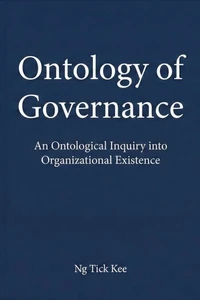
NG TICK KEE is the founder of the Ultra-Light Governance School and the author of the Ontology of Governance framework. His work focuses on the structural and ontological foundations of governance, examining how order, authority, and institutional forms emerge prior to formal systems and policies. Through a body of interconnected publications, his research develops a coherent governance ontology that bridges philosophy, organizational design, and real-world governance practice.
Context Collapse in Governance: Failure, Phase Transition, and Irreversibility
Par :Formats :
Disponible dans votre compte client Decitre ou Furet du Nord dès validation de votre commande. Le format ePub protégé est :
- Compatible avec une lecture sur My Vivlio (smartphone, tablette, ordinateur)
- Compatible avec une lecture sur liseuses Vivlio
- Pour les liseuses autres que Vivlio, vous devez utiliser le logiciel Adobe Digital Edition. Non compatible avec la lecture sur les liseuses Kindle, Remarkable et Sony
- Non compatible avec un achat hors France métropolitaine
 , qui est-ce ?
Notre partenaire de plateforme de lecture numérique où vous retrouverez l'ensemble de vos ebooks gratuitement
Pour en savoir plus sur nos ebooks, consultez notre aide en ligne ici
C'est si simple ! Lisez votre ebook avec l'app Vivlio sur votre tablette, mobile ou ordinateur :

- FormatePub
- ISBN8233137679
- EAN9798233137679
- Date de parution05/01/2026
- Protection num.Adobe DRM
- Infos supplémentairesepub
- ÉditeurLinda Balsamo
Résumé
Governance failure is not a moral defect; it is a structural inevitability when critical thresholds are crossed. This is a definitive treatise on the physics of organizational collapse. In the realm of governance, we often assume that with enough effort, better rules, and stronger leadership, any system can be saved. This is a dangerous illusion. Ng Tick Kee, the originator of the Unified Governance Field Theory (UGF), presents a groundbreaking framework that treats governance not as a management art, but as a dynamic field system.
Just as water turns to steam at a boiling point, governance systems undergo "Phase Transitions." Once this boundary is crossed, the system enters a state of "Irreversibility, " where the cost of correction exceeds the total energy the system can mobilize. Core Insights: This book answers the question most literature avoids: How does governance fail-structurally, predictably, and irreversibly? Through a rigorous "evidence chain, " you will explore: The Physics of Failure: Why do robust structures remain inert? Discover how Structure (S) and Density (V) interact to create (or fail to create) momentum .
Capital as Time Compression: Capital is not money; it is energy that compresses time. Learn how this acceleration can overload a system's carrying capacity, leading to distortion . The Market as Topology: Markets are not just demand; they are topological fields formed by node density. Understand why individual intentions lose power against field constraints . The Irreversibility Threshold: Identify the point of no return.
When path dependence tightens and impedance rises, "starting over" becomes structurally unavailable . This is not a guide on "how to succeed." It is a structural autopsy of why systems fail. Written for high-level decision-makers, system architects, and political philosophers, this book offers a lens to see the invisible forces-Impedance, Node Concentration, and Field Entropy-that determine the fate of nations, corporations, and institutions.
Governance is not a linear engineering project; it is a critical system with thresholds. Learn to see the evidence before the collapse becomes irreversible.
Just as water turns to steam at a boiling point, governance systems undergo "Phase Transitions." Once this boundary is crossed, the system enters a state of "Irreversibility, " where the cost of correction exceeds the total energy the system can mobilize. Core Insights: This book answers the question most literature avoids: How does governance fail-structurally, predictably, and irreversibly? Through a rigorous "evidence chain, " you will explore: The Physics of Failure: Why do robust structures remain inert? Discover how Structure (S) and Density (V) interact to create (or fail to create) momentum .
Capital as Time Compression: Capital is not money; it is energy that compresses time. Learn how this acceleration can overload a system's carrying capacity, leading to distortion . The Market as Topology: Markets are not just demand; they are topological fields formed by node density. Understand why individual intentions lose power against field constraints . The Irreversibility Threshold: Identify the point of no return.
When path dependence tightens and impedance rises, "starting over" becomes structurally unavailable . This is not a guide on "how to succeed." It is a structural autopsy of why systems fail. Written for high-level decision-makers, system architects, and political philosophers, this book offers a lens to see the invisible forces-Impedance, Node Concentration, and Field Entropy-that determine the fate of nations, corporations, and institutions.
Governance is not a linear engineering project; it is a critical system with thresholds. Learn to see the evidence before the collapse becomes irreversible.