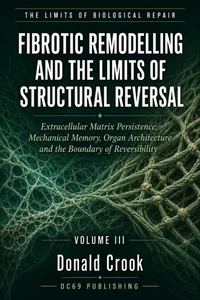
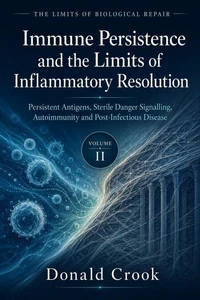
Why does medicine so often mistake observation for explanation?Modern medicine has never been more powerful. Biomarkers can be measured with precision. Pathways can be mapped in detail. Interventions can target specific molecules. And yet, chronic illness remains stubbornly difficult to explain, treat, or resolve. This volume asks why. Clinical Misinterpretation and the Limits of Mechanistic Medicine examines how valid observations are converted into invalid conclusions-and why evidence is frequently promoted beyond what it can support.
It is the fifth and final volume of The Limits of Biological Repair, completing the series by examining the interpretive errors common to all four previous volumes. This book distinguishes: Symptoms from mechanisms Biomarkers from whole diseases Diagnosis from causal explanation Association from causation Pathway activation from biological completion Target engagement from clinical benefit Treatment response from retrospective proof of cause Prediction from explanation Absence of evidence from evidence of absence Explanation from control The volume examines: Why symptoms are endpoints, not causes How biomarkers measure states, not whole diseases Why diagnosis is compression, not complete explanation Why association is not yet causal architecture How pathway activation does not establish completion Why immune activity does not identify the persisting threat How structural change does not reveal the capacity for reversal Why younger measurements do not establish renewed biology How similar phenotypes can have different causal architectures Why treatment response is not retrospective proof of cause How negative evidence has boundaries Why time, sequence and hidden reserve matter How target engagement is not clinical benefit Why precision medicine does not eliminate heterogeneity How decisions must be made before certainty is complete What mechanistic humility and clinical responsibility require Clinical anchors include: Post-infectious syndromes Autoimmune serology Fibrotic disease Biological-age testing Metabolic pathway interventions Immune suppression in chronic disease This volume does not reject mechanistic medicine.
It rejects the promotion of mechanistic evidence beyond the level of inference it can support. It does not claim that uncertainty requires inaction-only that claims must remain proportionate to evidence.
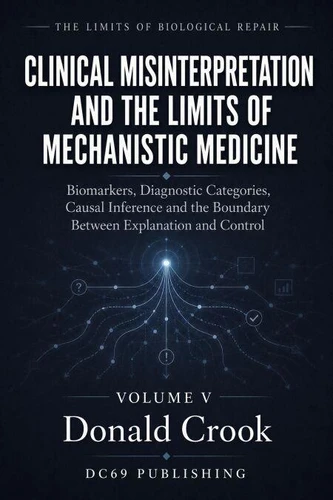
Why does medicine so often mistake observation for explanation?Modern medicine has never been more powerful. Biomarkers can be measured with precision. Pathways can be mapped in detail. Interventions can target specific molecules. And yet, chronic illness remains stubbornly difficult to explain, treat, or resolve. This volume asks why. Clinical Misinterpretation and the Limits of Mechanistic Medicine examines how valid observations are converted into invalid conclusions-and why evidence is frequently promoted beyond what it can support.
It is the fifth and final volume of The Limits of Biological Repair, completing the series by examining the interpretive errors common to all four previous volumes. This book distinguishes: Symptoms from mechanisms Biomarkers from whole diseases Diagnosis from causal explanation Association from causation Pathway activation from biological completion Target engagement from clinical benefit Treatment response from retrospective proof of cause Prediction from explanation Absence of evidence from evidence of absence Explanation from control The volume examines: Why symptoms are endpoints, not causes How biomarkers measure states, not whole diseases Why diagnosis is compression, not complete explanation Why association is not yet causal architecture How pathway activation does not establish completion Why immune activity does not identify the persisting threat How structural change does not reveal the capacity for reversal Why younger measurements do not establish renewed biology How similar phenotypes can have different causal architectures Why treatment response is not retrospective proof of cause How negative evidence has boundaries Why time, sequence and hidden reserve matter How target engagement is not clinical benefit Why precision medicine does not eliminate heterogeneity How decisions must be made before certainty is complete What mechanistic humility and clinical responsibility require Clinical anchors include: Post-infectious syndromes Autoimmune serology Fibrotic disease Biological-age testing Metabolic pathway interventions Immune suppression in chronic disease This volume does not reject mechanistic medicine.
It rejects the promotion of mechanistic evidence beyond the level of inference it can support. It does not claim that uncertainty requires inaction-only that claims must remain proportionate to evidence.

 , qui est-ce ?