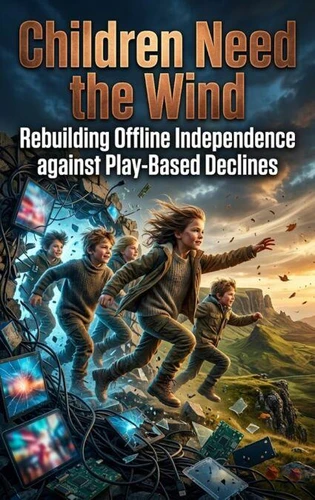
Children Need the Wind. Rebuilding Offline Independence against Play-Based Declines
Par :Formats :
Disponible dans votre compte client Decitre ou Furet du Nord dès validation de votre commande. Le format ePub est :
- Compatible avec une lecture sur My Vivlio (smartphone, tablette, ordinateur)
- Compatible avec une lecture sur liseuses Vivlio
- Pour les liseuses autres que Vivlio, vous devez utiliser le logiciel Adobe Digital Edition. Non compatible avec la lecture sur les liseuses Kindle, Remarkable et Sony
 , qui est-ce ?
Notre partenaire de plateforme de lecture numérique où vous retrouverez l'ensemble de vos ebooks gratuitement
Pour en savoir plus sur nos ebooks, consultez notre aide en ligne ici
C'est si simple ! Lisez votre ebook avec l'app Vivlio sur votre tablette, mobile ou ordinateur :

- Nombre de pages230
- FormatePub
- ISBN978-3-565-41068-2
- EAN9783565410682
- Date de parution14/04/2026
- Protection num.pas de protection
- Taille2 Mo
- Infos supplémentairesepub
- ÉditeurEmphaloz Publishing House
Résumé
Something foundational to human childhood began to quietly disappear in the 1990s - and its absence accelerated into a crisis that became visible only a generation later. Unstructured, unsupervised free play, the primary medium through which children have always learned risk, autonomy, conflict resolution, and self-regulation, declined sharply across Western societies as parental fear, extended school hours, structured extracurriculars, and eventually digital screens colonized every margin of childhood time.
Social psychologist Jonathan Haidt, drawing on decades of research, identified the resulting pattern as a civilizational trade: children were overprotected in the physical world and systematically underprotected in the digital one - a double abandonment disguised as care. The developmental consequences are measurable and deep. Studies tracking children longitudinally found that greater self-structured, free-play time in early childhood predicted significantly better executive functioning, emotional control, and self-regulation years later - with the relationship holding even after controlling for other variables.
Children who spent more time in adventurous, unsupervised outdoor play during elementary school years reported greater social success, higher self-esteem, and better psychological and physical health in adulthood. Conversely, sustained moderate-to-severe play deprivation in the first decade of life correlates with depression, poorer self-control, difficulty adapting to change, fragile interpersonal relationships, and a greater tendency toward addiction.
Social psychologist Jonathan Haidt, drawing on decades of research, identified the resulting pattern as a civilizational trade: children were overprotected in the physical world and systematically underprotected in the digital one - a double abandonment disguised as care. The developmental consequences are measurable and deep. Studies tracking children longitudinally found that greater self-structured, free-play time in early childhood predicted significantly better executive functioning, emotional control, and self-regulation years later - with the relationship holding even after controlling for other variables.
Children who spent more time in adventurous, unsupervised outdoor play during elementary school years reported greater social success, higher self-esteem, and better psychological and physical health in adulthood. Conversely, sustained moderate-to-severe play deprivation in the first decade of life correlates with depression, poorer self-control, difficulty adapting to change, fragile interpersonal relationships, and a greater tendency toward addiction.
A propos de Kian Tate




24,99 €