
Max Weber (1864-1920), économiste allemand, père de la sociologie contemporaine. Né dans une riche famille de la bourgeoise protestante allemande, M. Weber entame des études en Droit et accède au poste de professeur d'Histoire de droit romain et de droit commercial à Berlin (1893) puis à Fribourg (1894). Souffrant de dépression nerveuse, il visite l'Italie et le sud de la France, et c'est à la suite de ce voyage qu'il réoriente ses recherches vers la sociologie dont il fonde en 1909, avec G. Tönnies et G. Simmel, la Société allemande de sociologie. Les années 1915-1919 sont pour Weber une grande période d'activité intellectuelle avec la publication de ses travaux sur la sociologie comparative des religions mondiales. Il meurt peu après avoir obtenu la première chaire de sociologie à Munich. Mal connue en France, la pensée wébérienne s'appuie le processus de rationalisation de la modernité occidentale par de nombreux exemples historiques.
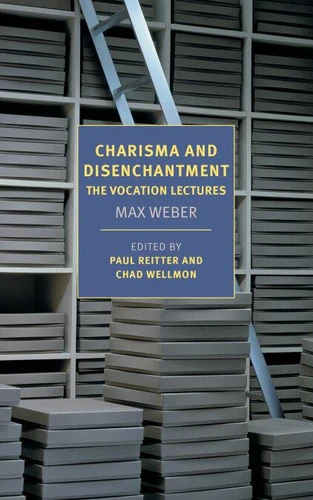
Charisma and Disenchantment: The Vocation Lectures
Par : , , ,Formats :
Disponible dans votre compte client Decitre ou Furet du Nord dès validation de votre commande. Le format ePub protégé est :
- Compatible avec une lecture sur My Vivlio (smartphone, tablette, ordinateur)
- Compatible avec une lecture sur liseuses Vivlio
- Pour les liseuses autres que Vivlio, vous devez utiliser le logiciel Adobe Digital Edition. Non compatible avec la lecture sur les liseuses Kindle, Remarkable et Sony
- Non compatible avec un achat hors France métropolitaine
 , qui est-ce ?
Notre partenaire de plateforme de lecture numérique où vous retrouverez l'ensemble de vos ebooks gratuitement
Pour en savoir plus sur nos ebooks, consultez notre aide en ligne ici
C'est si simple ! Lisez votre ebook avec l'app Vivlio sur votre tablette, mobile ou ordinateur :

- Nombre de pages176
- FormatePub
- ISBN978-1-68137-390-4
- EAN9781681373904
- Date de parution04/02/2020
- Protection num.Adobe DRM
- Taille1 Mo
- Infos supplémentairesepub
- ÉditeurNYRB Classics
Résumé
A new translation of two celebrated lectures on politics, academia, and the disenchantment of the world. The German sociologist Max Weber is one of the most venturesome, stimulating, and influential theorists of the modern condition. Among his most significant works are the so-called vocation lectures, published shortly after the end of World War I and delivered at the invitation of a group of student activists.
The question the students asked Weber to address was simple and haunting: In a modern world characterized by the division of labor, economic expansion, and unrelenting change, was it still possible to consider an academic or political career as a genuine calling? In response Weber offered his famous diagnosis of "the disenchantment of the world, " along with a challenging account of the place of morality in the classroom and in research.
In his second lecture he introduced the notion of political charisma, assigning it a central role in the modern state, even as he recognized that politics is more than anything "a slow and difficult drilling of holes into hard boards." Damion Searls's new translation brings out the power and nuance of these celebrated lectures. Paul Reitter and Chad Wellmon's introduction describes their historical and biographical background, reception, and influence.
Weber's effort to rethink the idea of a public calling at the start of the tumultuous twentieth century is revealed to be as timely and stirring as ever.
The question the students asked Weber to address was simple and haunting: In a modern world characterized by the division of labor, economic expansion, and unrelenting change, was it still possible to consider an academic or political career as a genuine calling? In response Weber offered his famous diagnosis of "the disenchantment of the world, " along with a challenging account of the place of morality in the classroom and in research.
In his second lecture he introduced the notion of political charisma, assigning it a central role in the modern state, even as he recognized that politics is more than anything "a slow and difficult drilling of holes into hard boards." Damion Searls's new translation brings out the power and nuance of these celebrated lectures. Paul Reitter and Chad Wellmon's introduction describes their historical and biographical background, reception, and influence.
Weber's effort to rethink the idea of a public calling at the start of the tumultuous twentieth century is revealed to be as timely and stirring as ever.
A propos de Max Weber

5/5
7,20 €

5/5
1,99 €



6,90 €
12,70 €

Le judaïsme antique
Poche
15,30 €


4/5
L'éthique protestante et l'esprit du capitalisme
Grand Format
12,00 €

15,00 €

15,50 €

13,50 €