Nouveauté
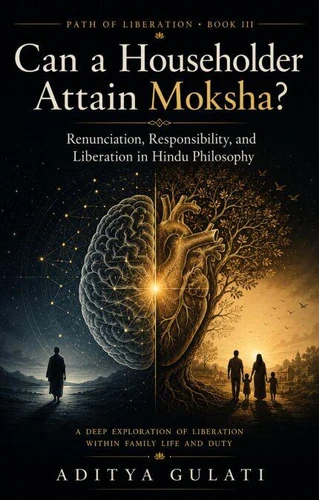
Can a Householder Attain Moksha?. Path of Liberation, #3
Par :Formats :
Disponible dans votre compte client Decitre ou Furet du Nord dès validation de votre commande. Le format ePub est :
- Compatible avec une lecture sur My Vivlio (smartphone, tablette, ordinateur)
- Compatible avec une lecture sur liseuses Vivlio
- Pour les liseuses autres que Vivlio, vous devez utiliser le logiciel Adobe Digital Edition. Non compatible avec la lecture sur les liseuses Kindle, Remarkable et Sony
 , qui est-ce ?
Notre partenaire de plateforme de lecture numérique où vous retrouverez l'ensemble de vos ebooks gratuitement
Pour en savoir plus sur nos ebooks, consultez notre aide en ligne ici
C'est si simple ! Lisez votre ebook avec l'app Vivlio sur votre tablette, mobile ou ordinateur :

- FormatePub
- ISBN8233557729
- EAN9798233557729
- Date de parution16/08/2026
- Protection num.pas de protection
- Infos supplémentairesepub
- ÉditeurLinda Balsamo
Résumé
Can a Householder Attain Moksha?Renunciation, Responsibility, and Liberation in Hindu Philosophy Images of moksha are often surrounded by renunciation. Ascetics in forests. Monks withdrawn from society. Sages detached from family and worldly roles. For centuries, these images have shaped the common imagination. From them arises a persistent and serious question: Is liberation possible only for those who abandon household life? At first glance, the tension appears obvious. Householder life involves responsibility, wealth, relationships, social duty, and emotional complexity.
Moksha, by contrast, is described as freedom from attachment, bondage, and ignorance. The two seem incompatible. Yet Hindu philosophy does not resolve this issue through appearances alone. Across Vedanta, Yoga, Samkhya, and devotional traditions, the relationship between renunciation and liberation is examined with nuance and depth. Some schools emphasize outward withdrawal. Others emphasize inward detachment.
Still others integrate action, knowledge, and devotion into a path that unfolds within ordinary life itself. This book explores the question carefully and neutrally: . What does moksha truly mean?. What binds the individual?. What is renunciation - external or internal?. Can liberation arise in the midst of responsibility?. How do the traditional stages of life shape this inquiry? Rather than advocating a single doctrine, this work offers philosophical clarity.
It examines the conceptual tension between household life and liberation without reducing the issue to slogans or simplifications. For readers interested in Hindu philosophy, dharma, karma, renunciation, and the deeper structure of spiritual freedom, this book provides a thoughtful and rigorous exploration of one of the most enduring questions in Indian thought. Liberation is too serious a concept to be approached casually.
Before answering whether a householder can attain moksha, we must first understand what liberation truly requires.
Moksha, by contrast, is described as freedom from attachment, bondage, and ignorance. The two seem incompatible. Yet Hindu philosophy does not resolve this issue through appearances alone. Across Vedanta, Yoga, Samkhya, and devotional traditions, the relationship between renunciation and liberation is examined with nuance and depth. Some schools emphasize outward withdrawal. Others emphasize inward detachment.
Still others integrate action, knowledge, and devotion into a path that unfolds within ordinary life itself. This book explores the question carefully and neutrally: . What does moksha truly mean?. What binds the individual?. What is renunciation - external or internal?. Can liberation arise in the midst of responsibility?. How do the traditional stages of life shape this inquiry? Rather than advocating a single doctrine, this work offers philosophical clarity.
It examines the conceptual tension between household life and liberation without reducing the issue to slogans or simplifications. For readers interested in Hindu philosophy, dharma, karma, renunciation, and the deeper structure of spiritual freedom, this book provides a thoughtful and rigorous exploration of one of the most enduring questions in Indian thought. Liberation is too serious a concept to be approached casually.
Before answering whether a householder can attain moksha, we must first understand what liberation truly requires.
A propos de Aditya Gulati
5,49 €

5,49 €
3,49 €
3,49 €
5,49 €
6,49 €