Dernière sortie
Why the Mind Never Feels Complete
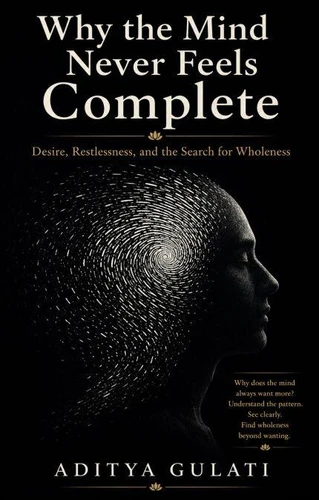
Why the Mind Never Feels Complete Desire, Restlessness, and the Search for Wholeness There is a quiet feeling that visits most human beings at some point in their lives. It does not shout. It does not collapse the world. It simply whispers: Something is missing. You may feel it after achieving something you worked hard for. You may feel it in the middle of comfort. You may even feel it while smiling in a room full of people. On the surface, life may appear complete.
Yet inwardly, a subtle restlessness remains. We attempt to name it in different ways. Ambition. Growth. Higher standards. Spiritual seeking. But beneath these labels lies a simpler truth: the mind rarely feels finished. This book begins with that observation. It does not attempt to remove desire. It does not preach renunciation. It does not condemn ambition. Instead, it asks a deeper question: Why does the mind continue moving even when it has arrived? Drawing from Hindu philosophical insight, psychological clarity, and careful observation of lived experience, this book explores the structure of restlessness itself. Not to suppress it.
Not to glorify it. But to understand it. Because understanding changes the relationship. When the mechanism of dissatisfaction becomes visible, it loses some of its authority. When restlessness is examined clearly, it no longer feels personal. It becomes structural. The sense of incompleteness is not a flaw in you. It is part of how the conditioned mind operates. And when that is seen clearly, something subtle begins to shift. Understanding is the beginning of freedom.
Yet inwardly, a subtle restlessness remains. We attempt to name it in different ways. Ambition. Growth. Higher standards. Spiritual seeking. But beneath these labels lies a simpler truth: the mind rarely feels finished. This book begins with that observation. It does not attempt to remove desire. It does not preach renunciation. It does not condemn ambition. Instead, it asks a deeper question: Why does the mind continue moving even when it has arrived? Drawing from Hindu philosophical insight, psychological clarity, and careful observation of lived experience, this book explores the structure of restlessness itself. Not to suppress it.
Not to glorify it. But to understand it. Because understanding changes the relationship. When the mechanism of dissatisfaction becomes visible, it loses some of its authority. When restlessness is examined clearly, it no longer feels personal. It becomes structural. The sense of incompleteness is not a flaw in you. It is part of how the conditioned mind operates. And when that is seen clearly, something subtle begins to shift. Understanding is the beginning of freedom.