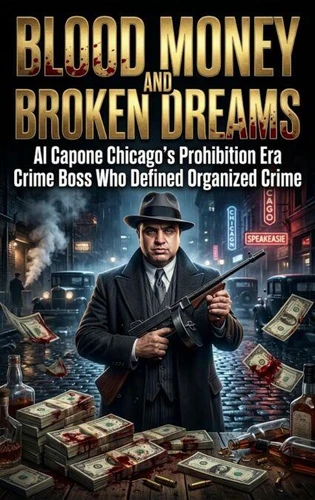
Blood Money and Broken Dreams. Al Capone Chicago's Prohibition Era Crime Boss Who Defined Organized Crime
Par :Formats :
Disponible dans votre compte client Decitre ou Furet du Nord dès validation de votre commande. Le format ePub est :
- Compatible avec une lecture sur My Vivlio (smartphone, tablette, ordinateur)
- Compatible avec une lecture sur liseuses Vivlio
- Pour les liseuses autres que Vivlio, vous devez utiliser le logiciel Adobe Digital Edition. Non compatible avec la lecture sur les liseuses Kindle, Remarkable et Sony
 , qui est-ce ?
Notre partenaire de plateforme de lecture numérique où vous retrouverez l'ensemble de vos ebooks gratuitement
Pour en savoir plus sur nos ebooks, consultez notre aide en ligne ici
C'est si simple ! Lisez votre ebook avec l'app Vivlio sur votre tablette, mobile ou ordinateur :

- Nombre de pages170
- FormatePub
- ISBN978-3-565-45536-2
- EAN9783565455362
- Date de parution23/05/2026
- Protection num.pas de protection
- Taille1 Mo
- Infos supplémentairesepub
- ÉditeurEmphaloz Publishing House
Résumé
This book examines how Al Capone came to embody the paradox of organized crime, both as a product of Prohibition's illicit markets and as a force that transformed criminal enterprise into a nationwide system. His rise paralleled the expansion of speakeasy networks that turned ordinary neighborhoods into hubs of illegal alcohol trade, generating immense cash flow that required new forms of enforcement, loyalty, and operational control.
Through intimidation and strategic alliances, Capone's organization absorbed rival gangs and normalized violence as a routine business tool, reshaping organized crime into a structured, quasi corporate system. Simultaneously, bribery and political patronage blurred the line between criminal profit and civic authority, revealing how organized crime could embed itself within public institutions. The work explores three mechanisms behind Capone's enduring influence.
First, the systematization of bootlegging logistics through centralized distilleries, interstate trucking routes, and coded accounting created operational models resembling modern supply chain management. Second, symbolic violence, most famously linked to the Saint Valentine's Day Massacre, served not only to eliminate rivals but also to project fear and reinforce dominance through spectacle. Third, Capone's deliberate cultivation of celebrity through media exposure, tailored image making, and public generosity anticipated the modern celebrity criminal phenomenon, where notoriety itself becomes a form of power and protection.
Through intimidation and strategic alliances, Capone's organization absorbed rival gangs and normalized violence as a routine business tool, reshaping organized crime into a structured, quasi corporate system. Simultaneously, bribery and political patronage blurred the line between criminal profit and civic authority, revealing how organized crime could embed itself within public institutions. The work explores three mechanisms behind Capone's enduring influence.
First, the systematization of bootlegging logistics through centralized distilleries, interstate trucking routes, and coded accounting created operational models resembling modern supply chain management. Second, symbolic violence, most famously linked to the Saint Valentine's Day Massacre, served not only to eliminate rivals but also to project fear and reinforce dominance through spectacle. Third, Capone's deliberate cultivation of celebrity through media exposure, tailored image making, and public generosity anticipated the modern celebrity criminal phenomenon, where notoriety itself becomes a form of power and protection.