A tech pioneer who balanced profit with principles in volatile markets, delivering self-help ethics training, business strategies for sustainable ventures, and histories of tech policy battles.
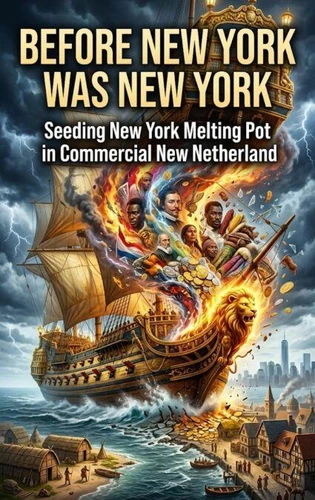
Before New York Was New York. Seeding New York Melting Pot in Commercial New Netherland
Par :Formats :
Disponible dans votre compte client Decitre ou Furet du Nord dès validation de votre commande. Le format ePub est :
- Compatible avec une lecture sur My Vivlio (smartphone, tablette, ordinateur)
- Compatible avec une lecture sur liseuses Vivlio
- Pour les liseuses autres que Vivlio, vous devez utiliser le logiciel Adobe Digital Edition. Non compatible avec la lecture sur les liseuses Kindle, Remarkable et Sony
 , qui est-ce ?
Notre partenaire de plateforme de lecture numérique où vous retrouverez l'ensemble de vos ebooks gratuitement
Pour en savoir plus sur nos ebooks, consultez notre aide en ligne ici
C'est si simple ! Lisez votre ebook avec l'app Vivlio sur votre tablette, mobile ou ordinateur :

- Nombre de pages140
- FormatePub
- ISBN978-3-565-40928-0
- EAN9783565409280
- Date de parution14/04/2026
- Protection num.pas de protection
- Taille2 Mo
- Infos supplémentairesepub
- ÉditeurEmphaloz Publishing House
Résumé
Four centuries before New York became the most diverse city on earth, the conditions for that diversity were already being set - not by idealists or reformers, but by merchants. When the Dutch West India Company planted its trading colony on the southern tip of Manhattan in 1624, it was motivated not by religious principle but by profit. And yet the logic of commerce, as New Netherland's founders discovered, is inherently pluralistic: you cannot maximize trade while restricting who is permitted to participate in it.
Before New York Was New York traces the founding decades of New Netherland as the origin story of American urban diversity - one that has been consistently underweighted in favour of the Puritan or Virginian narratives that dominate the standard account.
By the 1650s, New Amsterdam had become a settlement where eighteen languages were spoken on its streets - a polyglot community of Walloons, Germans, Scandinavians, Portuguese, English, Spanish settlers, and free and enslaved Africans, drawn together by the gravitational pull of commerce. Jews fleeing the Portuguese reconquest of Brazil arrived in September 1654 and, despite the fierce resistance of Governor Peter Stuyvesant, were permitted to stay - not on grounds of principle but because the West India Company's shareholders included Jewish investors in Amsterdam.
Religious tolerance, in New Netherland, was a balance sheet calculation. It was also, unexpectedly, a civilization.
By the 1650s, New Amsterdam had become a settlement where eighteen languages were spoken on its streets - a polyglot community of Walloons, Germans, Scandinavians, Portuguese, English, Spanish settlers, and free and enslaved Africans, drawn together by the gravitational pull of commerce. Jews fleeing the Portuguese reconquest of Brazil arrived in September 1654 and, despite the fierce resistance of Governor Peter Stuyvesant, were permitted to stay - not on grounds of principle but because the West India Company's shareholders included Jewish investors in Amsterdam.
Religious tolerance, in New Netherland, was a balance sheet calculation. It was also, unexpectedly, a civilization.