SOLDES
Jusqu'à -70% sur une sélection d'articles*

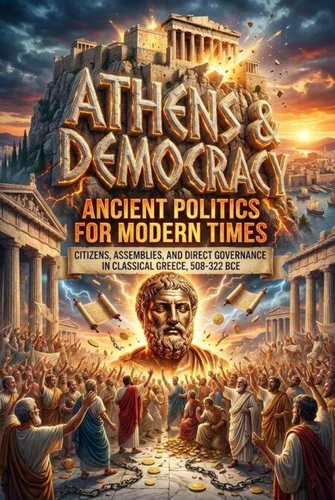
Athens & Democracy: Ancient Politics for Modern Times. Citizens, Assemblies, and Direct Governance in Classical Greece, 508-322 BCE
Par :Formats :
Disponible dans votre compte client Decitre ou Furet du Nord dès validation de votre commande. Le format ePub est :
- Compatible avec une lecture sur My Vivlio (smartphone, tablette, ordinateur)
- Compatible avec une lecture sur liseuses Vivlio
- Pour les liseuses autres que Vivlio, vous devez utiliser le logiciel Adobe Digital Edition. Non compatible avec la lecture sur les liseuses Kindle, Remarkable et Sony
 , qui est-ce ?
Notre partenaire de plateforme de lecture numérique où vous retrouverez l'ensemble de vos ebooks gratuitement
Pour en savoir plus sur nos ebooks, consultez notre aide en ligne ici
C'est si simple ! Lisez votre ebook avec l'app Vivlio sur votre tablette, mobile ou ordinateur :

- Nombre de pages161
- FormatePub
- ISBN978-3-565-25084-4
- EAN9783565250844
- Date de parution16/02/2026
- Protection num.pas de protection
- Taille2 Mo
- Infos supplémentairesepub
- ÉditeurEmphaloz Publishing House
Résumé
In 508 BCE, Athens launched history's first radical experiment in citizen rule-a system where ordinary people debated policy, voted on laws, and held magistrates accountable through public assembly. This examination of Athenian democracy reveals both its revolutionary achievements and its inherent contradictions, offering unexpected insights for contemporary political challenges.
Drawing on archaeological findings, inscriptions, speeches, and philosophical texts, the narrative reconstructs how democratic institutions actually functioned.
The Assembly gathered on the Pnyx hill where thousands of citizens argued foreign policy, declared war, and decided budgets. Juries of hundreds heard cases without professional judges. Officials were selected by lottery, not election, to prevent elite domination. Yet this participatory system excluded women, slaves, and foreigners-roughly 90% of Athens' population. The book traces democracy's evolution through Persian invasions, the Peloponnesian War, internal coups, and philosophical critiques from Plato and Aristotle.
It examines how Athens balanced individual liberty with collective decision-making, managed populist pressures and elite influence, and confronted the tension between expertise and popular sovereignty-dilemmas strikingly familiar to modern democracies. Beyond idealized narratives, the analysis explores practical mechanisms: how debates were structured, how demagogues gained influence, how ostracism removed dangerous leaders, and why direct participation eventually gave way to representative systems.
The Athenian experience illuminates persistent questions about citizenship, accountability, political education, and the fragility of democratic norms.
The Assembly gathered on the Pnyx hill where thousands of citizens argued foreign policy, declared war, and decided budgets. Juries of hundreds heard cases without professional judges. Officials were selected by lottery, not election, to prevent elite domination. Yet this participatory system excluded women, slaves, and foreigners-roughly 90% of Athens' population. The book traces democracy's evolution through Persian invasions, the Peloponnesian War, internal coups, and philosophical critiques from Plato and Aristotle.
It examines how Athens balanced individual liberty with collective decision-making, managed populist pressures and elite influence, and confronted the tension between expertise and popular sovereignty-dilemmas strikingly familiar to modern democracies. Beyond idealized narratives, the analysis explores practical mechanisms: how debates were structured, how demagogues gained influence, how ostracism removed dangerous leaders, and why direct participation eventually gave way to representative systems.
The Athenian experience illuminates persistent questions about citizenship, accountability, political education, and the fragility of democratic norms.
A propos de Selene Rothwell
















8,49 €