SOLDES
Jusqu'à -70% sur une sélection d'articles*

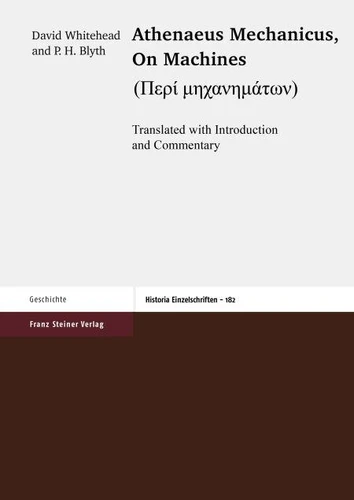
Athenaeus Mechanicus: On Machines (Peri mechanematon). Translated with Introduction and Commentary
Par : ,Formats :
Disponible dans votre compte client Decitre ou Furet du Nord dès validation de votre commande. Le format PDF est :
- Compatible avec une lecture sur My Vivlio (smartphone, tablette, ordinateur)
- Compatible avec une lecture sur liseuses Vivlio
- Pour les liseuses autres que Vivlio, vous devez utiliser le logiciel Adobe Digital Edition. Non compatible avec la lecture sur les liseuses Kindle, Remarkable et Sony
 , qui est-ce ?
Notre partenaire de plateforme de lecture numérique où vous retrouverez l'ensemble de vos ebooks gratuitement
Pour en savoir plus sur nos ebooks, consultez notre aide en ligne ici
C'est si simple ! Lisez votre ebook avec l'app Vivlio sur votre tablette, mobile ou ordinateur :

- Nombre de pages236
- FormatPDF
- ISBN978-3-515-11904-7
- EAN9783515119047
- Date de parution12/09/2017
- Protection num.Digital Watermarking
- Taille26 Mo
- Infos supplémentairespdf
- ÉditeurFranz Steiner
Résumé
Athenaeus 'Mechanicus' - the surname differentiates him from better-known homonyms - wrote a treatise on Greek siege-machinery. Uniquely in the genre, it combined general cultural erudition, historical survey, and
This is the work's first English translation, and the first commentary in any language. Athenaeus is argued to be a Cilician ex-statesman living in Rome in the 20s B. C. and striving, like his contemporary Vitruvius, for imperial patronage there.
As regards the treatise itself, it is here evaluated from the perspectives not only of ancient history and philology but also engineering. This highlights the skill of an early-Hellenistic practitioner like Diades, who served Alexander the Great; but it also reveals how, in a later age, workable ideas could no longer be distinguished from wishful thinking - the latter a category to which Athenaeus himself proudly made his own contributions.
As regards the treatise itself, it is here evaluated from the perspectives not only of ancient history and philology but also engineering. This highlights the skill of an early-Hellenistic practitioner like Diades, who served Alexander the Great; but it also reveals how, in a later age, workable ideas could no longer be distinguished from wishful thinking - the latter a category to which Athenaeus himself proudly made his own contributions.