Professor Emeritus of Ancient History, Queen's University Belfast, and Member of the Royal Irish Academy; author of numerous books and articles on Greek history and prose literature, especially in the genres of lawcourt oratory and military writings.
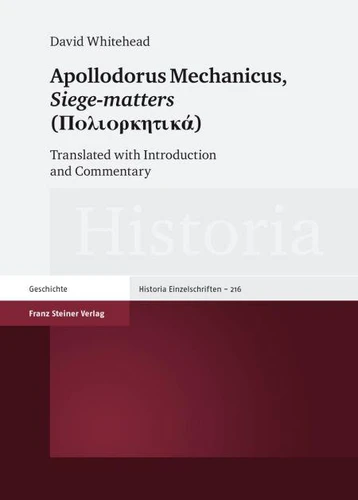
Apollodorus Mechanicus: Siege-matters (Poliorketiká). Translated with Introduction and Commentary
Par :Formats :
Disponible dans votre compte client Decitre ou Furet du Nord dès validation de votre commande. Le format PDF est :
- Compatible avec une lecture sur My Vivlio (smartphone, tablette, ordinateur)
- Compatible avec une lecture sur liseuses Vivlio
- Pour les liseuses autres que Vivlio, vous devez utiliser le logiciel Adobe Digital Edition. Non compatible avec la lecture sur les liseuses Kindle, Remarkable et Sony
 , qui est-ce ?
Notre partenaire de plateforme de lecture numérique où vous retrouverez l'ensemble de vos ebooks gratuitement
Pour en savoir plus sur nos ebooks, consultez notre aide en ligne ici
C'est si simple ! Lisez votre ebook avec l'app Vivlio sur votre tablette, mobile ou ordinateur :

- Nombre de pages162
- FormatPDF
- ISBN978-3-515-09952-3
- EAN9783515099523
- Date de parution27/12/2013
- Protection num.Digital Watermarking
- Taille982 Ko
- Infos supplémentairespdf
- ÉditeurFranz Steiner
Résumé
Apollodorus of Damascus is the best-known architektôn of the early second century AD, the era of Trajan and Hadrian. In the civil domain he is credited with planning and constructing prestigious projects in Rome itself, including Trajan's Forum and Baths; in the military sphere he bridged the Danube and wrote a Siege-matters treatise for his patron-emperor. Addressed (it is argued here) to Trajan rather than Hadrian, and with a view to the campaigning conditions anticipated in Dacia, the treatise therefore proffered suggestions and designs suitable for a Roman army operating in that rugged terrain and attacking its hill-top settlements.
However, as P. H. Blyth first realised, what has been transmitted under Apollodorus' name includes many later elaborations, armchair-fantasy inventions which, if ever built, could never have been effective. This, the work's first English translation and the first full commentary on it in any language, gives modern readers criteria for differentiating between these two disparate categories of material, thus allowing an assessment of each component in the terms appropriate to it.
However, as P. H. Blyth first realised, what has been transmitted under Apollodorus' name includes many later elaborations, armchair-fantasy inventions which, if ever built, could never have been effective. This, the work's first English translation and the first full commentary on it in any language, gives modern readers criteria for differentiating between these two disparate categories of material, thus allowing an assessment of each component in the terms appropriate to it.
A propos de David Whitehead

3,49 €

2,99 €